

In B2B transactions, billing doesn’t always go as planned — goods arrive damaged, invoices carry errors, or a supplier misses a charge entirely. Sorting these out verbally isn’t enough. Businesses need a formal document that records the adjustment, keeps both parties aligned, and holds up for accounting and compliance purposes.
That’s what a debit note is for. This guide covers its meaning, when it’s used, how it works, and what it must include.
What is a Debit Note?
A debit note is a formal document used to adjust the amount owed between a buyer and a seller after an invoice has already been issued. It can flow in either direction — a buyer raises one to reduce what they owe, while a seller may raise one to recover an amount that was missed or undercharged.
Think of it as the official paper trail for correcting a billing discrepancy, without having to void the original invoice. It is also referred to as: debit memo, debit memorandum, or purchase return note.
Note: An invoice requests payment. A debit note requests a correction to an existing transaction, adjusting the amount either up or down, depending on who raises it and why.
When is a Debit Note Used?
Businesses issue debit notes in various situations where adjustments to past transactions are needed. Here are some common cases:
1. Damaged or incorrect goods – If the received products are faulty or don’t match the order, a debit note is issued to request a refund or price adjustment.
2. Invoice errors – When an overcharge is spotted in a bill, a debit note serves as a formal record to correct the amount.
3. Missed discounts – If a discount was supposed to be applied but wasn’t reflected in the invoice, a debit note helps claim the difference.
4. Returning goods – When sending items back to a supplier, a debit note helps keep track of the return and the expected refund or credit.
How does a Debit Note Work?
The process follows a clear flow to ensure every adjustment is properly documented and resolved:
Issue identification – The buyer spots a discrepancy in the transaction — damaged goods, incorrect pricing, or a missed charge.
Documentation – A debit note is prepared with the reason for adjustment, the amount, and a reference to the original invoice.
Submission – The debit note is sent to the seller along with any supporting evidence, such as photographs of damaged goods or delivery records.
Verification – The seller reviews the claim and validates the discrepancy against their own records.
Resolution – Once accepted, the seller adjusts their accounts and typically issues a credit note to confirm the adjustment on their end.
When a debit note is processed, it directly affects both sides of the books — the buyer’s accounts payable goes down, and the seller’s accounts receivable adjusts accordingly.
Debit Note vs Credit Note — What’s the Difference?
While both documents are used to correct billing discrepancies, they serve opposite purposes and are raised by different parties.
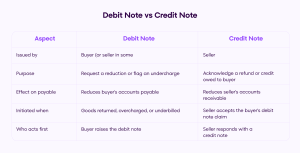
In most cases, the two go hand in hand — the buyer raises a debit note, and the seller issues a credit note to close out the same transaction.
Key Details in a Debit Note
A properly formatted debit note should contain several essential elements to ensure clarity and proper processing:
- Document header: Clearly marked as “Debit Note” with a unique reference number
- Date: The date of issue
- Description: Description of the goods
- Contact information: Complete details of both buyer and seller
- Original invoice reference: Number and date of the related invoice
- Amount: The sum being claimed or adjusted
- Tax implications: Any tax adjustments that need to be considered
- Terms and conditions: Any specific conditions or notes regarding the adjustment
Importance of Debit Notes
1. Records Adjustments: It formally documents reductions in the amount payable due to errors, returns, or other adjustments.
2. Ensures Transparency: Helps maintain clear financial records between buyers and sellers.
3. Legal Compliance: In GST-compliant transactions, debit notes help in adjusting tax liabilities correctly. As per GST rules, a debit note must be reported in GSTR-1 to ensure accurate tax filings.
4. Facilitates Return Process: Acts as proof when returning goods due to defects, excess supply, or quality issues.
5. Reduces Disputes: Provides a structured way to communicate transaction discrepancies, reducing conflicts.
Best Practices for Using Debit Notes
To maximize the effectiveness of debit notes in your business operations:
- Issue promptly: Send debit notes as soon as discrepancies are discovered to ensure timely resolution.
- Maintain records: Keep copies of all debit notes along with supporting documentation.
- Follow up: Monitor the status of submitted debit notes and follow up with sellers if necessary.
- Digital integration: Consider using accounting software that can generate and track debit notes automatically.
Managing debit notes doesn’t have to be manual. Open’s AP automation lets you track, raise, and reconcile debit notes directly within your accounting workflow — so nothing slips through the cracks. From invoice mismatches to purchase returns, every adjustment is logged and accounted for in one place.
Conclusion
Debit notes play a crucial role in modern business transactions by helping companies maintain accurate financial records and efficiently resolve payment discrepancies. Whether addressing damaged goods, incorrect charges, or post-invoice adjustments, proper use of debit notes can save time and prevent complications. Clear communication and thorough documentation are essential for effective financial management, ensuring smooth operations and strong relationships with suppliers and business partners.
FAQs
- When is a debit note issued?
A debit note is raised when a transaction needs correcting after an invoice has already been sent — most commonly when goods arrive damaged, quantities are short, or there’s a billing error. It can also be issued by a seller when they’ve undercharged and need to recover the difference.
- Who issues a debit note — the buyer or the seller?
Usually, the buyer. They raise it to flag an overcharge, a return, or a discrepancy in what was delivered versus what was invoiced. Sellers can issue one too, typically when they’ve missed billing for shipping, taxes, or additional charges.
- Is a debit note a refund request?
Not exactly. A debit note formally records that an adjustment is needed; the actual refund or credit comes later, usually in the form of a credit note from the seller. The debit note kicks off the process; it doesn’t complete it.
- What is the difference between a debit note and a credit note?
A debit note is raised to request an adjustment, either reducing what the buyer owes or flagging an undercharge. A credit note is the seller’s response, confirming the adjustment and reducing the buyer’s outstanding balance. The two documents typically work together to close out a correction.
- Is a debit note the same as an invoice?
No. An invoice requests payment for goods or services delivered. A debit note corrects or adjusts an invoice that’s already been issued — it doesn’t initiate a new transaction.