
Key Takeaways
- Rule-based systems fall short: Traditional ERPs fail to catch duplicate invoices when fraudsters introduce slight variations (e.g., INV-01 vs. INV-1) to bypass exact-match logic.
- AI looks for patterns, not just exact matches: Machine learning uses fuzzy matching and behavior analysis to detect suspiciously similar invoices and split payments.
- Vendor master data is the frontline: Many AP frauds originate from unauthorized changes to vendor bank details; strict onboarding and change-verification controls are non-negotiable.
- Unified AP prevents leakage: Integrating OCR capture, 3-way matching, and automated approvals into one connected system stops duplicate payments before funds are disbursed.
Duplicate invoice fraud is one of the most common and most preventable sources of financial leakage in accounts payable.
The scenario is familiar to many finance teams. A vendor submits an invoice, it gets approved and paid, and a few weeks later, the same invoice appears again with a slightly modified reference number. The amount is identical, and by the time someone notices, the payment has already gone through.
This is not an isolated occurrence. Research from Celonis shows that duplicate payment rates typically range between 0.1% and 0.5% of total outgoing payments, and can reach as high as 1.5% in some organisations. Even at the lower end of that range, a company processing $100 million in annual payments could lose hundreds of thousands of dollars each year to duplicate payments.
The root cause is rarely negligence. It lies in how traditional AP processes operate — invoices arriving through multiple channels, approvals spread across systems, and teams managing large volumes under tight timelines. As digital payments scale, AP fraud prevention in India is becoming a critical priority. In the sections below, we look at the most common AP fraud risks and how AI-powered systems are helping finance teams detect anomalies and prevent duplicate payments before they happen.
What Is Accounts Payable Fraud?
Accounts payable fraud refers to any deceptive activity designed to manipulate the invoice-to-payment process for financial gain.
In most cases, fraud targets weaknesses in invoice processing, vendor management, or payment approval workflows.
Unlike other financial fraud types, AP fraud often occurs gradually. Small irregularities go unnoticed until the financial impact becomes significant.
Effective AP fraud prevention in India requires a combination of process controls, vendor verification, and automated monitoring systems that detect suspicious transactions before payments are released.
Common Types of Accounts Payable Fraud
Finance teams typically encounter several recurring fraud patterns within AP operations.
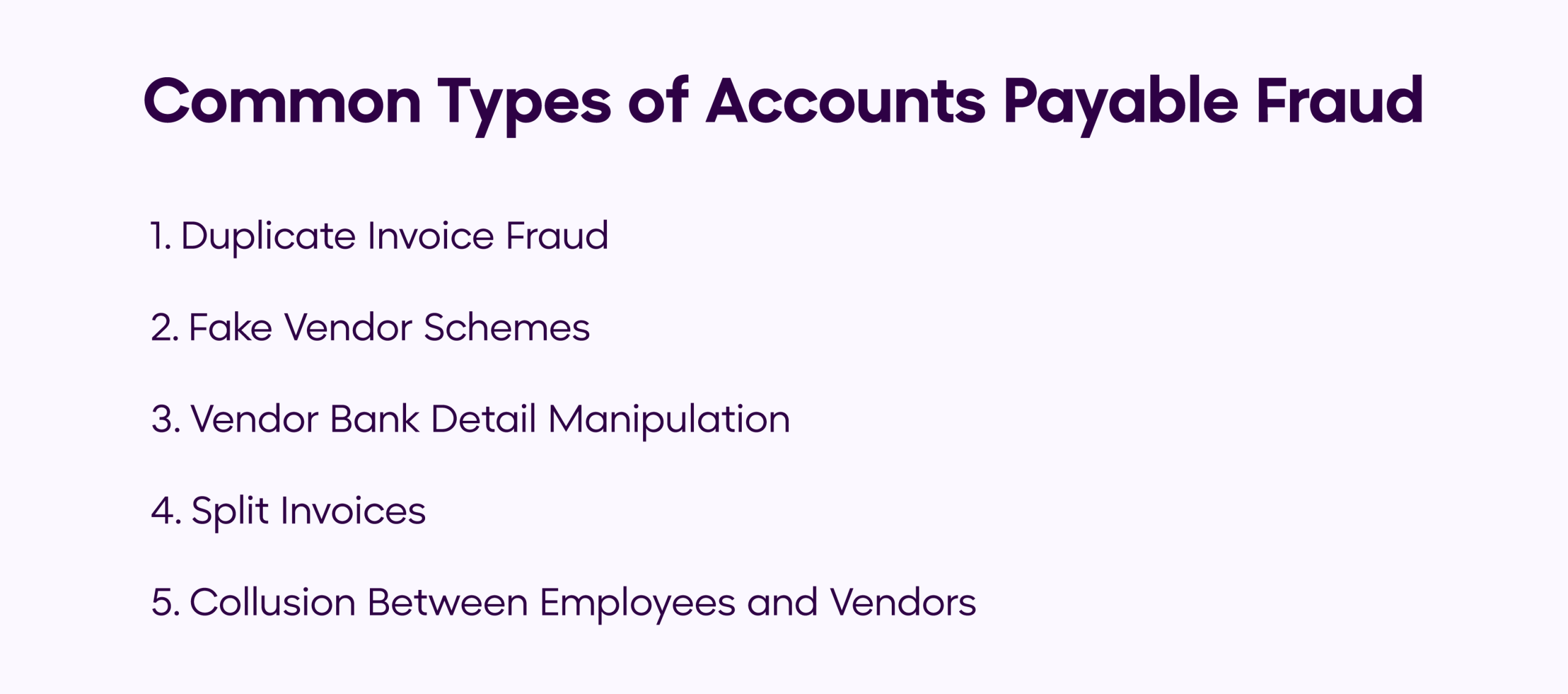
1. Duplicate Invoice Fraud
The same invoice is submitted multiple times with minor variations in invoice number, format, or submission channel.
2. Fake Vendor Schemes
Fraudsters create fictitious vendors within the vendor master database and submit invoices for payment.
3. Vendor Bank Detail Manipulation
A legitimate vendor’s bank details are altered before a payment run, diverting funds to a fraudulent account.
4. Split Invoices
Large invoices are divided into smaller amounts to bypass approval thresholds.
5. Collusion Between Employees and Vendors
Internal staff collaborates with vendors to approve fraudulent invoices or inflate invoice values.
Because these schemes are designed to mimic legitimate transactions, they are difficult to detect using manual review alone.
Core AP Fraud Prevention Strategies in India
Effective accounts payable fraud prevention in India relies on multiple layers of control.
Finance teams typically combine operational policies, compliance checks, and automated monitoring systems.
Key AP fraud prevention strategies include:
1. AI-Driven Invoice Screening
Modern AP automation platforms use machine learning to detect anomalies such as:
- Duplicate invoices
- Unusual payment patterns
- Round-number payments
- Sudden vendor activity spikes
These systems continuously analyze invoice data to identify potential fraud risks.
2. Rigorous Vendor Onboarding
Organizations should verify vendor information before onboarding by checking:
- GSTIN validation
- PAN details
- Bank account verification
- Registered business addresses
This reduces the risk of fictitious vendors entering the payment system.
3. Segregation of Duties
AP controls should ensure that the same person cannot both approve invoices and execute payments.
Dual approval workflows help maintain accountability and prevent unauthorized transactions.
4. Vendor Change Verification
Any request to change vendor bank details should trigger verification procedures, including:
- Confirmation calls to trusted vendor contacts
- Internal approval for vendor record updates
This prevents fraudulent payment redirection.
5. Regular Internal Audits
Periodic reviews of AP transactions help detect anomalies such as:
- Duplicate payments
- Suspicious vendor activity
- Unusual invoice patterns
Together, these controls form the foundation of effective AP fraud prevention programs.
Why Traditional Duplicate Detection Often Fails
Most ERP systems detect duplicates using exact-match logic across fields such as:
- Vendor name
- Invoice number
- Invoice amount
- Invoice date
This approach works for identical invoices but fails when small changes are introduced.
For example:
- INV-891 vs INV-0891
- ABC Traders vs ABC Traders Pvt Ltd
- The same invoice was submitted via different channels
Fraudsters intentionally introduce these small variations to bypass automated checks.
This is why finance teams increasingly rely on AI-based duplicate invoice detection instead of traditional rules-based systems.
How OPEN Helps Prevent Duplicate Invoice Fraud
Preventing AP fraud requires more than invoice scanning. It requires a connected system where vendor verification, invoice validation, approvals, and payments are integrated.
OPEN AP brings these processes together within a unified accounts payable automation platform.
With OPEN AP, finance teams can:
- Capture invoices automatically through OCR-based extraction
- Detect duplicate invoices using intelligent validation checks
- Perform three-way matching between invoices, purchase orders, and GRNs
- Route invoices through structured approval workflows
- Maintain a complete audit trail for every transaction
- Execute payments through connected banking infrastructure
By combining automation, verification, and structured controls, finance teams can significantly reduce duplicate payments while improving operational efficiency.
Discover how OPEN AP helps finance teams strengthen AP fraud prevention.
Learn more →
How AI Detects Duplicate Invoices That Traditional Systems Miss
AI-powered AP systems analyze invoices using pattern recognition rather than strict rule matching.
Instead of checking whether an invoice is identical, AI asks a more relevant question:
Does this invoice look suspiciously similar to one already processed?
Key AI capabilities include:
Fuzzy Matching
AI compares multiple invoice fields simultaneously and identifies near duplicates even when small variations exist.
Vendor Behavior Analysis
Machine learning models analyze historical vendor activity and detect unusual billing patterns.
Document Similarity Detection
AI can compare invoice PDFs and scanned documents to identify structural similarities.
Split Invoice Detection
The system identifies clusters of invoices submitted within short timeframes that appear designed to bypass approval limits.
Cross-System Validation
Invoices are checked against purchase orders, goods receipt notes, and historical records to confirm transaction authenticity.
These capabilities significantly improve duplicate payment prevention.
The Vendor Master Problem: Where Many AP Frauds Begin
Many AP fraud incidents originate not with invoices but with changes to vendor records.
A typical attack involves requesting an update to vendor bank details. Once the update is approved, the next payment run transfers funds to the fraudulent account.
AI-powered monitoring systems detect these risks by flagging:
- Vendor bank account changes before payment runs
- Multiple vendors sharing bank accounts
- Large payments to newly created vendors
- GSTIN or PAN inconsistencies
For Indian businesses, GSTIN validation during vendor onboarding provides an additional compliance safeguard.
Why Audit Trails Matter in AP Fraud Prevention
Fraud detection alone is not enough. Finance teams must also demonstrate that proper controls were followed.
Modern AP platforms maintain automated audit trails that document every step of the invoice lifecycle, including:
- invoice receipt
- data extraction
- validation checks
- approval workflows
- payment execution
These records help organizations demonstrate compliance during audits and regulatory reviews.
An AI-powered audit trail in finance ensures that every action in the AP workflow is traceable.
The Future of AP Fraud Prevention in India
As businesses grow and payment volumes increase, manual oversight becomes increasingly difficult. Finance teams need systems that can continuously monitor transactions, detect anomalies, and enforce controls without slowing down operations.
AI-powered technologies are enabling finance teams to move from reactive fraud detection to proactive prevention. Capabilities such as duplicate invoice detection, AP anomaly detection, automated audit trails, and intelligent vendor verification are becoming essential components of modern accounts payable operations.
Organizations that adopt these technologies are not only preventing fraud — they are building stronger financial governance frameworks that support sustainable growth.
Platforms like OPEN AP help finance teams bring these capabilities together by combining invoice automation, vendor verification, approval workflows, and connected payments within a single system.
See how OPEN AP can help strengthen your AP controls and prevent duplicate payments.
FAQs
What is AP fraud prevention in India?
AP fraud prevention refers to the processes and controls used to detect and stop fraudulent invoices, duplicate payments, and vendor manipulation within accounts payable workflows.
What is the most common type of accounts payable fraud?
Duplicate invoices and vendor bank account manipulation are among the most common AP fraud schemes.
How does AI help prevent AP fraud?
AI analyzes invoice data, vendor behavior, and transaction patterns to identify anomalies and potential fraud before payments are executed.
Why is vendor verification important in AP fraud prevention?
Most fraud doesn’t start with a fake invoice — it starts with a change to vendor records. Verifying GSTIN, PAN, and bank details during onboarding and flagging any subsequent changes before a payment run is one of the most effective ways to close that gap.
What features should companies look for in AP fraud prevention software?
Key features include duplicate invoice detection, vendor verification, approval workflow controls, automated audit trails, and real-time payment monitoring.