
Key Takeaways
- The shift to agentic workflows: AP automation is moving beyond simple OCR and static rules to AI agents that understand context, make decisions, and autonomously orchestrate the invoice lifecycle.
- Intelligent capture and validation: Modern AI reads invoices like a human would—extracting data across varied vendor formats and instantly validating it against POs and GRNs.
- Proactive exception handling: Instead of getting stuck in bottlenecks, AI agents flag anomalies (like duplicates or mismatches) and automatically route them to the correct approver.
- Strategic finance at scale: By taking over manual coordination, AI agents allow finance teams to handle higher invoice volumes without adding headcount, shifting their focus to vendor relationships and cash flow optimization.
As companies scale, accounts payable is often one of the first finance functions to feel the pressure.
Invoice volumes increase, vendor networks expand, and exceptions become more frequent. What once worked for a smaller finance team can quickly strain under the weight of hundreds—or even thousands—of invoices moving across procurement, operations, and finance.
Even with OCR and workflow automation, AP teams still spend significant time verifying invoice details, resolving discrepancies, and coordinating approvals. The result is slower payment cycles, higher cost per invoice, and limited visibility into the overall invoice-to-pay process.
A new shift is beginning to change this model: AI agents in accounts payable.
Unlike traditional automation that simply follows predefined rules, AI agents can interpret documents, understand context, detect anomalies, and trigger actions across systems. Often referred to as agentic AP automation, this approach moves accounts payable from simple task automation toward intelligent workflow orchestration.
In this blog, we explore how AI agents are transforming the accounts payable function—from AI-powered invoice capture to autonomous approval workflows and fully automated invoice-to-pay operations.
What Are AI Agents in Accounts Payable?
AI agents in accounts payable are intelligent systems designed to perform AP tasks autonomously using machine learning, document recognition, and large language models (LLMs).
Traditional AP automation tools rely heavily on rule-based logic. AI agents, however, can interpret information, evaluate context, and decide the next action within a workflow.
In a modern AI-driven accounts payable process, an AI system can:
- Extract invoice data from emails, PDFs, or vendor portals
- Validate vendor information and tax identifiers
- Perform invoice, PO, and GRN matching
- Detect duplicate or suspicious invoices
- Route invoices through approval workflows
- Trigger payment readiness and reconciliation
Instead of acting as a single automation tool, the AI functions more like a digital finance operator, coordinating multiple steps across the entire accounts payable lifecycle.
The Evolution of Accounts Payable Automation
Accounts payable automation has evolved significantly over the past decade.
1. Manual AP
Invoices are entered manually into accounting systems.
Approvals and tracking are handled through emails, spreadsheets, or paper documents.
2. OCR-Based Automation
OCR tools extract text from invoices, reducing manual data entry.
However, finance teams still validate data and manage workflow coordination manually.
3. Workflow Automation
Modern AP platforms introduce structured approval workflows, accounting integrations, and centralized invoice management.
4. Agentic AP Automation
AI agents now interpret invoices, validate financial data, detect anomalies, and coordinate approvals autonomously across systems.
This evolution marks a shift from task automation to intelligent financial process orchestration.
Why Accounts Payable Is Ideal for Agentic AI
Accounts payable is one of the most automation-ready functions within finance operations.
The workflow combines structured financial data with repetitive operational tasks—making it particularly suitable for AI-powered automation.
Most AP processes involve:
- High volumes of recurring invoices
- Standardized financial validations
- Predictable approval hierarchies
- Frequent supplier transactions
Because of these characteristics, AI agents can learn patterns across invoices, identify anomalies, and automate large portions of the invoice-to-pay workflow.
For finance leaders, this results in:
- Faster invoice processing cycles
- Reduced manual intervention
- Improved financial accuracy
- Greater operational scalability
As a result, AI in accounts payable is rapidly emerging as one of the most widely adopted AI applications in finance operations.
AI Invoice Capture: The First Layer of Transformation
One of the most visible applications of AI in accounts payable today is automated invoice capture.
Traditional OCR systems extract text from documents, but often struggle with variations in invoice layouts across vendors.
Modern AI invoice processing systems use machine learning and computer vision to interpret invoices regardless of format.
These systems can automatically:
- Identify invoice numbers and dates
- Extract vendor details and tax information
- Capture line items and pricing data
- Calculate totals and tax values
In many cases, LLM-powered invoice processing models now assist by understanding the context of the document instead of simply reading text.
For organizations handling large supplier networks, this significantly reduces time spent on manual invoice entry while improving data accuracy.
How AI Agents Manage the Invoice-to-Pay Workflow
A modern AI-driven AP workflow typically follows several intelligent steps.
1. Invoice Capture and Extraction
AI agents ingest invoices from email inboxes, vendor portals, or file uploads. Using OCR and LLM-based extraction, they identify key fields such as vendor name, invoice number, line items, GST details, and due dates.
2. Data Validation and Matching
The system compares extracted data with purchase orders, contracts, and goods receipt notes. Any discrepancies are automatically flagged.
3. Exception Detection
If an invoice does not match the PO or exceeds predefined thresholds, the AI routes it to the appropriate approver along with contextual information.
4. Approval Orchestration
AI agents determine the correct approval chain based on rules such as invoice amount, department, vendor category, or cost center.
5. Payment Readiness
Once approved, invoices are scheduled for payment, synced with accounting systems, and prepared for reconciliation.
6. Continuous Monitoring
AI systems track invoice status, approval timelines, and exceptions in real time—ensuring invoices do not remain stuck in the workflow.
How OPEN Enables AI-Driven Accounts Payable Automation
Managing invoices, purchase orders, and delivery confirmations across disconnected systems often creates operational complexity for finance teams.
OPEN brings these processes together within a unified accounts payable platform, enabling finance teams to manage the entire invoice-to-pay workflow in one place.
With OPEN AP, businesses can:
- Capture invoices using OCR-based invoice extraction
- Perform three-way matching between invoices, purchase orders, and GRNs
- Route invoices through structured approval workflows
- Maintain a complete audit trail for every transaction
OPEN also integrates compliance checks and payments within the same workflow. Vendor GSTIN and PAN validation during onboarding reduces compliance risks and protects Input Tax Credit eligibility.
Once approved, you can execute payments directly from connected bank accounts—no manual portal logins or file uploads needed. From invoice capture to payment, OPEN delivers end-to-end AP automation with strong financial controls.
The Shift Toward Autonomous Finance Operations
AI agents are not just improving individual AP tasks—they are gradually transforming how finance operations are structured.
In traditional AP environments, finance teams spend a large portion of their time coordinating invoices, approvals, and payment schedules.
With agentic automation, many of these activities move toward straight-through processing, where invoices move across the workflow with minimal manual intervention.
This allows finance teams to focus on higher-value activities such as:
- Managing vendor relationships
- Resolving complex exceptions
- Monitoring financial risk
- Optimizing working capital
Over time, this shift enables accounts payable teams to operate less as transactional processors and more as strategic partners within finance.
Benefits of AI Agents in Accounts Payable
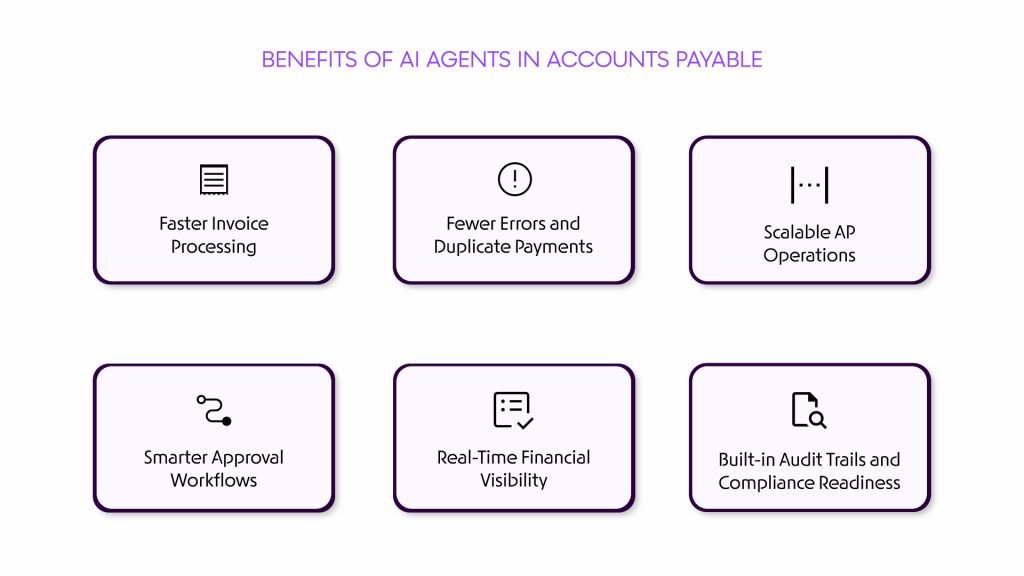
1. AI Automates Invoice Capture and Routing
AI agents automatically capture invoice data, validate key fields, and route invoices to the appropriate workflow. This significantly reduces manual data entry and speeds up invoice processing across the accounts payable cycle.
2. AI Detects Anomalies Before Payment
AI agents identify duplicate invoices, mismatched amounts, and missing information before payments are released. This helps finance teams prevent costly errors and reduces the risk of duplicate or incorrect payouts.
3. Intelligent Routing for Faster Approvals
Invoices are automatically sent to the correct approvers based on predefined rules such as department, vendor, or invoice value. This eliminates manual follow-ups and ensures approvals happen faster and more consistently.
4. Track Invoice Status Across the AP Workflow
AI-powered AP systems provide real-time visibility into invoice status, approvals, and exceptions. Finance teams can monitor the entire accounts payable process without relying on manual tracking or email threads.
5. Handle Higher Invoice Volumes Without More Manual Work
As businesses grow, invoice volumes increase. AI agents allow finance teams to scale accounts payable operations without expanding manual workloads, enabling teams to process more invoices efficiently.
Conclusion
Accounts payable is entering a new phase of automation driven by AI agents.
From intelligent invoice capture to autonomous approval routing, modern AP systems can now manage large portions of the invoice-to-pay lifecycle while maintaining financial accuracy and control.
For finance leaders, the opportunity extends beyond faster invoice processing. AI-driven accounts payable automation enables organizations to transform AP from a manual coordination function into a scalable, data-driven financial operation.
As businesses continue adopting AI across finance, platforms that combine document processing, financial controls, compliance validation, and integrated payments within a unified workflow will define the next generation of accounts payable operations.
OPEN AP brings these capabilities together within a unified accounts payable platform. From invoice capture to payment execution, it helps finance teams automate workflows while maintaining strong financial controls.
FAQs
What are AI agents in accounts payable?
AI agents in accounts payable are intelligent systems that automate tasks such as invoice extraction, document matching, anomaly detection, and approval routing.
Can AI replace accounts payable teams?
AI can automate repetitive tasks like invoice capture and validation, but finance professionals remain essential for handling disputes, compliance, and financial oversight.
What is AI invoice extraction?
AI invoice extraction uses machine learning to capture invoice data such as vendor details, line items, taxes, and totals from different invoice formats.
How does AI improve invoice capture?
Modern automated invoice capture tools combine OCR with machine learning models to interpret invoice layouts and extract structured data with higher accuracy.
Is AP automation growing in India?
Yes. Many businesses are adopting AP automation in India to manage increasing invoice volumes, improve financial accuracy, and reduce manual processing time.