

Key Takeaways
- Scale breaks rigid rules: Traditional, rule-based GST matching systems struggle with real-world vendor errors and formatting quirks, leading to mountains of manual review and false positives.
- AI adapts to messy data: Intelligent GST reconciliation uses fuzzy logic to match records that aren’t perfectly identical, learning from past corrections to improve future accuracy.
- Contextual ITC management: Instead of just flagging mismatches, AI analyzes vendor filing behaviors to help finance teams prioritize high-risk discrepancies over simple timing differences.
- From detection to prediction: Modern systems shift the focus from merely finding errors to proactively assessing compliance risk, helping enterprises stay ahead of potential tax notices.
GST reconciliation has steadily evolved from a periodic compliance activity into a more continuous, data-heavy process. While filings remain periodic, enterprises increasingly perform reconciliation throughout the month to manage volumes and reduce last-minute discrepancies.
For organizations handling large transaction volumes across multiple systems, reconciliation is no longer just about matching numbers. It now plays a key role in ensuring accuracy, maintaining audit readiness, and minimizing compliance risk.
In this environment, the shift toward more intelligent systems, including AI GST reconciliation in India, is becoming increasingly relevant. As data complexity grows, enterprises need solutions that can go beyond static matching and handle real-world variations more effectively.
What is GST Reconciliation?
GST reconciliation is the process of matching data across different GST returns, books of accounts, and supporting records to ensure consistency and accuracy. It typically involves comparing details from returns such as GSTR-1, GSTR-3B, and GSTR-2B with internal financial records.
The objective is to identify discrepancies in reported transactions, tax liabilities, and input tax credit. This helps businesses correct errors, claim eligible ITC accurately, and maintain compliance with GST regulations.
The Growing Complexity of GST Reconciliation
At its core, GST reconciliation involves matching data across multiple returns, books of accounts, and external records. While this sounds straightforward, enterprise-scale operations introduce several layers of complexity.
Businesses today deal with:
- Thousands or even millions of invoices every month
- Multiple ERP systems and data sources
- Frequent amendments in returns
- Vendor-side inconsistencies in reporting
A key area where this complexity becomes visible is GSTR-1 and GSTR-3B reconciliation. Differences between outward supply data and tax liability reported across these returns are not uncommon. These gaps can arise due to timing differences, classification issues, or simple reporting errors.
Without a robust reconciliation process, such inconsistencies can lead to compliance exposure and increased scrutiny.
Why Rule-Based Systems Are No Longer Enough
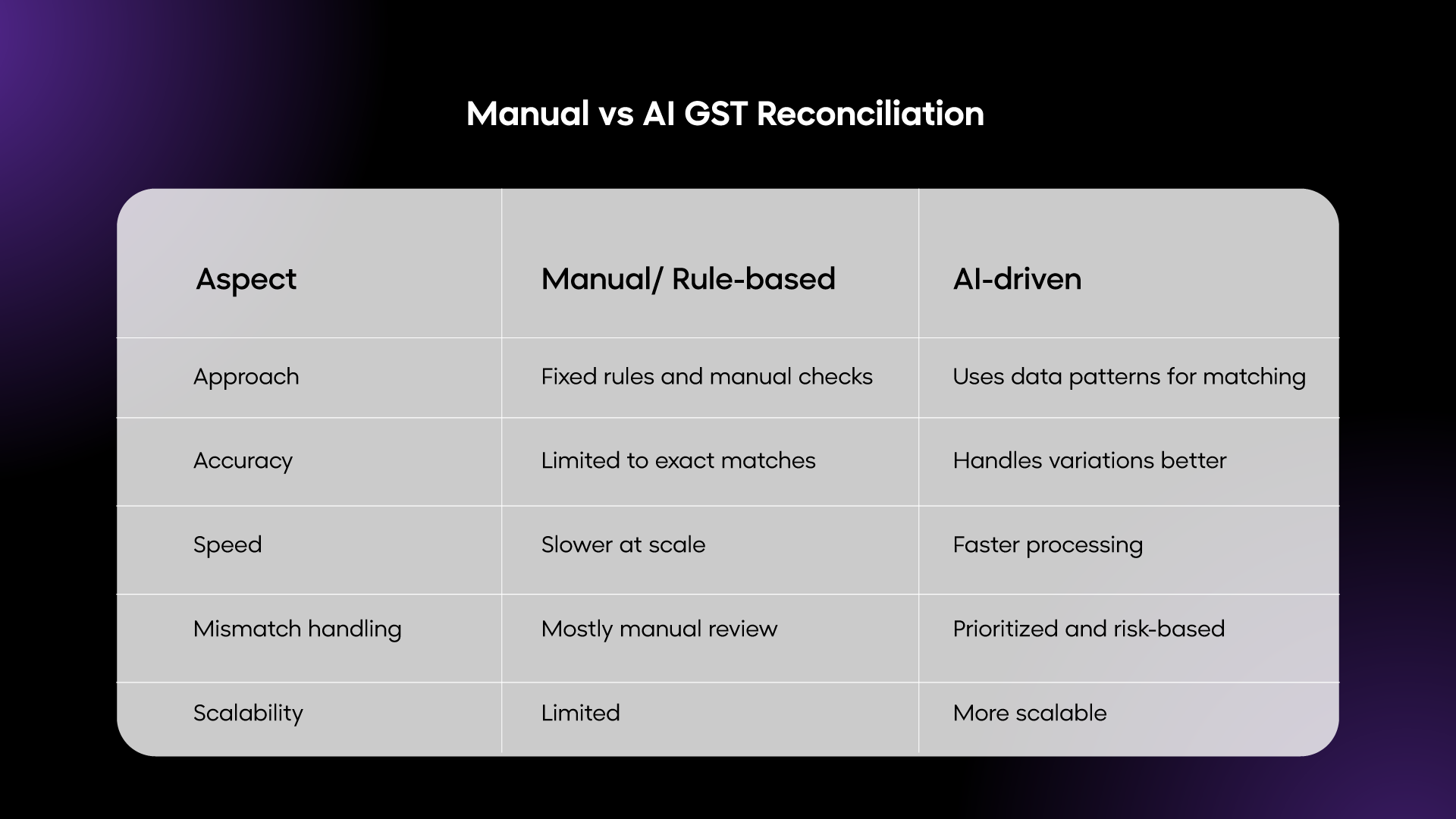
Traditional reconciliation systems are built on predefined rules. These rules match invoices based on exact or near-exact parameters such as GSTIN, invoice number, taxable value, and tax amounts.
While effective in controlled environments, rule-based systems struggle with the variability seen in real-world data.
For example:
- A minor difference in invoice formatting can break a match
- Vendor errors can create mismatches that are not actual compliance issues
- Amendments may not be properly linked to original entries
As a result, enterprises often deal with:
- High volumes of mismatches that require manual review
- False positives that slow down reconciliation cycles
- Delayed identification of genuine compliance issues
Even with automated GST reconciliation, these limitations persist because the system still depends on fixed logic.
The Shift Toward Automated GST Reconciliation
To manage scale, enterprises have already moved toward automated GST reconciliation. Automation has significantly improved efficiency by reducing manual effort and enabling faster data processing.
Key benefits include:
- Standardization of data formats across systems
- Faster matching of large datasets
- Reduced dependency on spreadsheets and manual checks
Automation also supports better tracking of input tax credit and overall reconciliation status. However, it still operates within predefined rules.
This means that while automation improves speed, it does not fully address the challenge of interpreting mismatches.
Introducing Intelligence Into Reconciliation
This is where AI starts to make a meaningful difference. Instead of relying only on rules, AI-driven systems analyze patterns, learn from historical data, and improve decision-making over time.
With AI GST reconciliation in India, enterprises can move toward a more adaptive reconciliation process.
AI-enabled systems can:
- Identify patterns in vendor filing behavior
- Detect anomalies that fall outside standard matching logic
- Classify mismatches based on risk levels
- Continuously improve accuracy based on past corrections
This reduces the burden on finance teams and allows them to focus on high-impact issues instead of reviewing every mismatch.
Handling ITC Mismatches More Effectively
Input Tax Credit remains one of the most sensitive areas in GST compliance. Errors or mismatches can directly impact working capital and may attract scrutiny.
Traditional systems flag mismatches but provide little context, often leading to time-consuming investigations.
With ITC mismatch AI, enterprises can approach this more effectively.
AI systems can:
- Analyze historical reconciliation data to identify common mismatch patterns
- Indicate whether mismatches are likely due to timing differences or actual discrepancies
- Prioritize mismatches that require immediate attention
For example, if a vendor consistently files returns with delays, AI can recognize this pattern and help reduce unnecessary escalation for similar cases in the future.
This improves efficiency and supports more accurate ITC management.
Also read: Why accurate GST reconciliation can save you from notices & penalties.
From Detection to Risk Assessment
One of the most significant advantages of AI-driven reconciliation is the shift from detection to risk assessment.
Traditional reconciliation answers one question: what does not match?
AI adds another layer: what could become a problem?
Through capabilities often described as GST notice prediction, systems can:
- Flag transactions that may attract scrutiny based on historical patterns
- Identify high-risk vendors with inconsistent compliance behavior
- Highlight unusual trends in tax reporting
It is important to note that these systems do not predict notices in a literal sense. Instead, they provide a risk-based view that helps enterprises prepare in advance.
This proactive approach allows businesses to address potential issues earlier and reduce potential compliance exposure.
Enhancing Accuracy in Return Matching
Accurate return matching remains central to compliance. AI enhances GSTR-1 and GSTR-3B reconciliation by improving the quality of matches.
Instead of relying only on exact matches, AI can:
- Use fuzzy logic to match records with minor differences
- Learn from past corrections to refine future matching
- Adjust matching thresholds based on data patterns
This helps ensure that valid transactions are not incorrectly flagged and that genuine discrepancies are identified more effectively.
For enterprises, this leads to faster reconciliation cycles and improved confidence in reported data.
The Role of GST Reconciliation Software
Modern GST reconciliation software in India is designed to combine automation with intelligence. These platforms integrate with enterprise systems and provide a centralized view of reconciliation status.
Typical capabilities include:
- Integration with ERP and accounting systems
- Automated data ingestion from GST returns
- Real-time or near real-time reconciliation dashboards
- Vendor compliance tracking
- Detailed audit trails for reconciliation actions
These systems also support the handling of amendments, reversals, and complex transaction scenarios commonly seen in large organizations.
As reconciliation becomes more complex, having the right system in place makes a clear difference.
Optotax helps enterprises streamline automated GST reconciliation, improve accuracy in return matching, and gain better visibility into ITC and reconciliation status. Built for scale, it supports finance teams in managing reconciliation more efficiently while staying audit-ready.
How to Choose the Best GST Reconciliation Software
Choosing the right GST reconciliation solution requires careful evaluation. Not all tools offer the same level of capability, scalability, or reliability, especially for enterprise use cases.
When evaluating a solution, enterprises should consider:
- Integration with existing systems
The software should seamlessly integrate with ERP and accounting platforms to ensure smooth data flow. - Scalability
It should be able to handle large volumes of transactions without compromising performance. - Accuracy and transparency
Look for solutions that clearly explain how matches and mismatches are identified, ensuring better control and auditability. - Adaptability to regulatory changes
GST regulations evolve over time, so the system should be flexible enough to accommodate updates without disruption. - Data security and audit readiness
Strong access controls, audit trails, and secure data handling are essential for enterprise environments.
It is also important to ensure that the system allows for human oversight. While AI can improve efficiency, final compliance responsibility always rests with the business.
The Road Ahead
GST compliance is becoming increasingly data-intensive. As reporting requirements evolve and transaction volumes grow, reconciliation will continue to play a critical role in financial operations.
The move toward AI GST reconciliation in India reflects a broader shift in how enterprises approach compliance. It is no longer just about meeting filing requirements, but about building systems that can handle scale, reduce risk, and provide better visibility into financial data.
Enterprises that invest in intelligent reconciliation today are better positioned to manage future complexity. They can close their books faster, respond to audits with greater confidence, and maintain stronger control over their tax positions.
FAQs
1. What is AI GST reconciliation?
AI GST reconciliation uses machine learning techniques to analyze GST data, improve matching accuracy, and identify patterns in mismatches. It goes beyond rule-based systems by learning from historical data and supporting more efficient reconciliation.
2. How is automated GST reconciliation different from AI-driven reconciliation?
Automated GST reconciliation relies on predefined rules to match data and reduce manual effort. AI-driven reconciliation builds on this by adding intelligence, enabling systems to learn from patterns, improve matching over time, and handle exceptions more effectively.
3. How does AI help with ITC mismatches?
With ITC mismatch AI, systems analyze past data and vendor behavior to classify mismatches, reduce false positives, and help prioritize issues that require attention. Final validation, however, still requires human review.
4. What is meant by GST notice prediction?
GST notice prediction refers to the use of data analysis and AI to identify transactions or patterns that may carry a higher compliance risk. It helps businesses take preventive action, but it does not literally predict notices from authorities.