

Key Takeaways
- India’s GST, TDS, and e-invoicing requirements make AP automation more complex here than anywhere else. Global platforms treat compliance as an add-on. That gap matters.
- The right tool depends on your ERP, invoice volume, and whether you need full procure-to-pay or just payment execution.
- Businesses processing 200+ invoices monthly typically see ROI within 6–9 months.
- Start with your top 20 vendors by volume. That’s where 60–70% of the benefit is.
A practical guide to evaluating AP automation platforms — with honest takes on what each tool does well and where it falls short.
Why AP Automation Matters More in India
Accounts payable is the hidden cost centre that most fast-growing Indian companies ignore until it breaks. Manual invoice processing, chasing approvals over WhatsApp, reconciling GST credits after the fact — it’s time-consuming, error-prone, and completely unscalable.
India’s compliance environment makes this harder than in most markets. Every invoice touches GST, many touch TDS, and businesses above ₹5 crore turnover have mandatory e-invoicing requirements. A platform that handles AP well in the US or Europe may handle AP poorly in India.
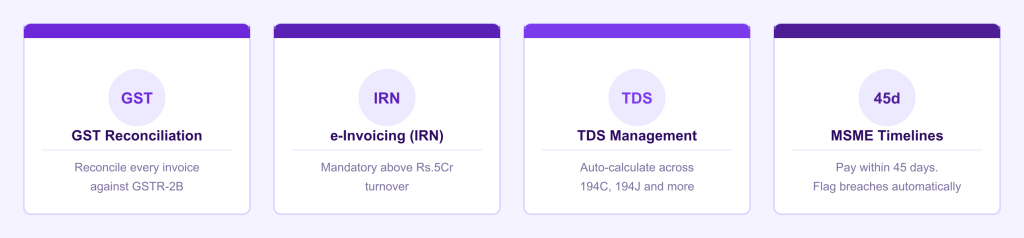
The Four India-Specific Requirements You Cannot Ignore
- GST Reconciliation: Every invoice must reconcile against GSTR-2B to claim input tax credit. Manual reconciliation at scale is a finance team’s nightmare.
- e-Invoicing (IRN): Businesses above ₹5 crore must validate Invoice Reference Numbers via the IRP portal. Your AP system must handle this natively.
- TDS Management: TDS calculation, deduction, and reporting under the correct section (194C, 194J, etc.) for every vendor payment — automated.
- MSME Payment Timelines: The MSME Development Act requires payment within 45 days. Late payments carry legal risk. Your AP system should flag these automatically.
What to Look for in an AP Automation Platform
| Feature | Why It Matters | Priority |
| OCR invoice capture | Eliminates manual data entry at source | Must-have |
| 3-way PO matching | Core fraud and error prevention | Must-have |
| GST reconciliation (GSTR-2B) | ITC claim automation | Must-have (India) |
| e-Invoice IRN validation | GST compliance for ₹5Cr+ businesses | Must-have (India) |
| TDS calculation engine | Tax compliance at every payment | Must-have (India) |
| MSME SLA tracking | Legal compliance under MSME Act | Must-have (India) |
| Approval workflow builder | Internal controls and audit trail | Must-have |
| ERP integration (Tally, SAP, Zoho) | Eliminates double-entry | Must-have |
| Vendor self-service portal | Reduces exception volume at source | Nice-to-have |
| Early payment discount capture | Cash flow optimisation | Nice-to-have |
| Multi-entity support | Required for group companies | Depends on structure |
| Cross-border payments | For globally scaling businesses | Nice-to-have |
Platform Comparison at a Glance
| Platform | GST / TDS Native | e-Invoicing | 3-Way Match | ERP Integration | Best For |
| OPEN | Native | Native | Yes | Tally, Zoho, SAP | Mid to Large enterprises |
| Mysa | Native | Native | Yes | Tally, Zoho, ERPNext | India-first startups |
| Volopay | Partial | No | No | Xero, QBO, NetSuite | Global-first companies |
| Zoho Books | Partial | Partial | No | Zoho ecosystem | Early-stage, Zoho users |
| SAP Concur | Via config | Via config | Yes | SAP ERP | Large enterprises |
| Happay | Limited | No | No | Limited | T&E focused companies |
| Razorpay Vendor Payments | Partial | No | No | Limited | High-volume disbursements |
Note: ‘Native’ = available out of the box. ‘Via config’ = available with implementation effort. Based on publicly available documentation as of early 2026.
Platform Reviews
#1 — OPEN AP Automation · Our Recommendation
OPEN is purpose-built for India. GST reconciliation, TDS management, e-invoicing validation, and MSME tracking are first-class features — not afterthoughts bolted onto a global platform. The full AP workflow runs from invoice receipt to bank payment within a single product.
Where OPEN separates itself from Mysa — its closest India-native competitor — is the integrated spend management layer. Corporate cards, reimbursements, and vendor payments share a single dashboard and budget view, giving finance teams complete visibility across all outflows from one place. Mysa handles the AP workflow well; OPEN handles the entire financial control surface.
Strengths: Native India compliance (GST, TDS, e-invoicing, MSME). Invoice-to-payment in one product. Tally and Zoho integration without workarounds. Integrated spend management across cards, reimbursements, and AP. Vendor onboarding with GSTIN verification.
Limitations: Multi-entity consolidation and group-company structures are less mature than enterprise-grade platforms — complex holding structures may require workarounds. ERP integrations are native for Tally and Zoho; SAP and Oracle integrations rely on API middleware. Businesses processing highly non-standard invoice formats (construction sub-contracts, milestone billing) should test OCR accuracy during the pilot.
Best for: Series A–C companies, D2C brands, tech startups, and any Indian business that wants native compliance and unified spend visibility without SAP-level implementation cost.
#2 — Mysa
Mysa is the most direct competitor to OPEN and deserves a serious look. It is purpose-built for Indian AP automation with native GST, TDS (including RCM), and e-invoicing support. Its 22-point invoice validation engine is the most rigorous of any platform in this list — covering duplicate detection, TDS interest penalties, amount mismatches, and bill number changes.
Mysa’s strongest differentiator is its invoice intelligence depth. The OCR is specifically trained on Indian invoice formats, and the validation logic goes further than most platforms in catching compliance edge cases before they reach the payment stage.
Where it falls short of OPEN is breadth: Mysa is focused on AP automation and does not offer the integrated corporate card and reimbursement layer that OPEN provides. For businesses that need AP and spend management in one product, OPEN is the stronger choice. For businesses that want best-in-class AP automation specifically, Mysa is a legitimate contender.
Strengths: Native India compliance (GST, TDS, RCM). Industry-leading 22-point invoice validation. Tally, Zoho, and ERPNext integration. AI-powered OCR trained on Indian invoice formats. Strong audit trail and governance controls.
Limitations: No integrated corporate card or reimbursement product. Smaller team (24 employees as of 2025) — enterprise support capacity is a fair question. Less proven at very large invoice volumes.
Best for: India-first startups and SMBs who want deep AP compliance automation and are happy to manage cards and expenses through a separate tool.
#3 — Volopay
Volopay is best understood as a spend management platform that includes AP features, rather than an AP automation platform that includes spend management. Its core strength is cross-border payments — supporting vendor payouts to 130+ countries with competitive FX rates — and corporate card controls for distributed or internationally-oriented teams.
On India-specific AP compliance, Volopay is noticeably weaker than OPEN or Mysa. GST and TDS support is partial, e-invoicing is not natively supported, and 3-way PO matching is absent. Its accounting integrations lean toward global platforms (Xero, QuickBooks, NetSuite) rather than India-native ones (Tally, Zoho Books).
For a company that is primarily India-focused with significant vendor compliance requirements, Volopay is not the right fit. For a company that is scaling globally — with international vendor payments, multi-currency expenses, and distributed teams — Volopay’s strengths are more relevant.
Strengths: Cross-border payments to 130+ countries with competitive FX rates. Strong corporate card controls and virtual card features. Good multi-currency expense visibility. Wide accounting software integrations (Xero, QBO, NetSuite).
Limitations: Weak India compliance depth — no native e-invoicing, limited TDS automation. No 3-way PO matching. Tally integration absent. Not designed for invoice-heavy AP workflows.
Best for: Globally scaling companies with international vendor payments as a primary need, where India-specific compliance depth is less critical.
#4 — Zoho Books / Zoho Invoice
Zoho Books handles GST reporting and basic AP workflows well at a competitive price. If your business already runs on Zoho CRM and Zoho People, the integration is seamless and the learning curve is low. The limitation is that it is an accounting tool with AP features, not an AP automation tool — there is no 3-way matching, and approval workflows are basic compared to purpose-built platforms.
Strengths: Excellent value for early-stage companies. Deep Zoho ecosystem integration. Good GST reporting out of the box.
Limitations: No 3-way PO matching. Limited approval workflow customisation. Not built for AP at scale (200+ invoices/month).
Best for: Companies already running on the Zoho ecosystem that need solid GST reporting and basic AP workflow without adding another platform to their stack. The right tool for the job at that scale — and a sensible starting point before volume justifies a dedicated AP automation layer.
#5 — SAP Concur
SAP Concur is the enterprise-grade standard — powerful, deeply configurable, and well-suited to large organisations with complex multi-entity structures. India compliance is achievable but requires implementation effort and configuration; it is not native. The real constraint is cost and complexity: SAP Concur makes sense at 1,000+ employees with an existing SAP ERP. Below that threshold, the implementation overhead rarely justifies the investment.
Strengths: Enterprise-grade configurability. Deep SAP ERP integration. Proven at very large scale.
Limitations: India compliance requires significant configuration. High implementation cost and timeline. Priced for enterprises — not SMB-viable.
Best for: Large enterprises (1,000+ employees) already on SAP ERP.
#6 — Happay
Happay (acquired by CRED) is genuinely strong for corporate card management and travel expense automation. However, it is not an AP automation platform in the full sense: there is no PO matching, limited vendor management, and e-invoicing is not supported.
Strengths: Best-in-class corporate card controls. Strong T&E workflow automation.
Limitations: Not a full AP automation tool. No 3-way matching. Weak on India compliance depth.
Best for: Companies prioritising travel and expense automation over full procure-to-pay workflow.
#7 — Razorpay Vendor Payments
Razorpay’s vendor payment product excels at high-volume payment execution — reliable reconciliation and strong support for NEFT, RTGS, and UPI. What it does not do is the upstream AP workflow: invoice capture, approval routing, PO matching, and compliance management all need to happen elsewhere. Most companies use it as the payment execution layer alongside a separate AP tool.
Strengths: Excellent for high-frequency disbursements. Reliable multi-rail bank integrations.
Limitations: Payment execution only — not end-to-end AP. No invoice capture, matching, or compliance.
Best for: Businesses that need payment execution automation and already have AP workflow handled elsewhere.
How to Evaluate and Choose
- Map your current process first. Document every step from invoice receipt to payment. Count your monthly invoice volume and identify where errors or delays actually happen. Most teams discover their real bottleneck is not where they expected.
- Verify India compliance features hands-on. Ask vendors to demo GST reconciliation against a real GSTR-2B file and TDS calculation on a multi-section vendor. Confirm e-invoicing IRN validation works natively, not via a third-party workaround.
- Test ERP integration specifically. Confirm native integration with your accounting system — Tally, Zoho Books, SAP, or QuickBooks. A CSV import/export workflow is not an integration. Push a test batch of invoices through and verify the data lands correctly.
- Run a live pilot. Process 50–100 real invoices during the evaluation. Ask vendors what percentage of invoices process without manual intervention — that number predicts live performance better than any demo.
- Calculate your specific ROI. Use your actual invoice volume, actual FTE costs, and actual error rates. Generic benchmarks are directional at best.
ROI Estimate: 300 Invoices/Month
The following uses conservative estimates for a business processing 300 invoices per month with a ₹2 crore monthly AP spend. Your numbers will vary based on complexity and current process maturity.
| Cost / Saving Area | Manual Process | With AP Automation | Monthly Saving |
| AP team time (1.5 FTE at ₹40K/month) | ₹60,000 | ₹20,000 (0.5 FTE) | ₹40,000 |
| Exception handling (~100/month) | ₹50,000 | ₹10,000 | ₹40,000 |
| Missed early payment discounts (2% on ₹20L eligible) | ₹40,000 lost | ₹40,000 captured | ₹40,000 |
| GST ITC leakage (~0.5% of invoice value) | ₹10,000 | ₹1,000 | ₹9,000 |
| Total monthly benefit | — | — | ~₹1.29 lakh |
These figures are illustrative estimates. Exception handling cost assumes ₹500 per exception in staff time. ITC leakage is based on industry patterns for manual reconciliation. Early payment discount rate will vary by vendor agreement. Verify against your own data before using in internal business cases.
At a platform cost of ₹20,000–50,000/month, payback at this volume typically occurs within 3–6 months. The ROI compounds as invoice volumes grow without adding headcount.