

Goods and Services Tax (GST) has simplified indirect tax compliance for businesses. However, even after years of implementation, many businesses still receive tax notices due to avoidable errors in filing returns. These errors often arise from incorrect reporting, missed deadlines, or a misunderstanding of GST rules. Recognising and correcting these issues early can help businesses stay compliant, prevent penalties, and avoid unnecessary scrutiny from tax authorities.
Below, we discuss five common GST filing errors that repeatedly trigger tax notices and how to prevent them.
Common Mistakes in GST
1. Mismatch Between GSTR-1 and GSTR-3B
One of the most common mistakes in GST is a mismatch between the details reported in Form GSTR-1 and Form GSTR-3B. GSTR-1 contains invoice-level details of outward supplies, while GSTR-3B is a summary return that captures tax liability, input tax credit, and net tax payable for a tax period.
In an ideal scenario, the tax liability declared in both returns should be consistent. However, mismatches often occur due to data entry errors, missed invoices, or timing differences in reporting transactions.
Why this error matters
The GST system regularly compares outward supplies reported in GSTR-1 with the tax paid through GSTR-3B. If the tax paid is lower than the liability disclosed in GSTR-1, or if large mismatches continue over multiple periods, the department may issue notices seeking clarification or payment of differential tax.
How to avoid it
- Perform a monthly reconciliation of sales registers with GST returns.
- Use accounting or GST filing software to upload invoice data directly and reduce manual errors.
- Finalise GSTR-1 first and cross-verify the figures before filing GSTR-3B.
2. Incorrect Input Tax Credit (ITC) Claims
Incorrect claims of Input Tax Credit are another major source of GST notices. ITC allows businesses to offset the tax paid on purchases against the tax payable on sales, but only for eligible supplies and compliant invoices.
Typical ITC mistakes
- Claiming ITC that does not reflect in the auto-generated GSTR-2B due to the delayed, incorrect, or non-filing of returns by suppliers.
- Claiming ITC on ineligible or blocked items under GST rules, such as personal expenses or specific categories of goods and services restricted under law.
- Overstating credit due to duplicate entries or incorrect invoice details.
Consequences
If ITC does not match GSTR-2B or is claimed on blocked items, the excess credit may be reversed along with applicable interest. In certain cases, penalties may also apply. Such discrepancies often lead to GST notices seeking explanations and corrective action.
How to avoid it
- Regularly reconcile purchase registers with the auto-generated GSTR-2B.
- Follow up with suppliers to ensure timely and accurate return filing.
- Clearly understand ITC restrictions under Section 17(5) and avoid claiming blocked credits.
3. Late Filing and Missing Deadlines
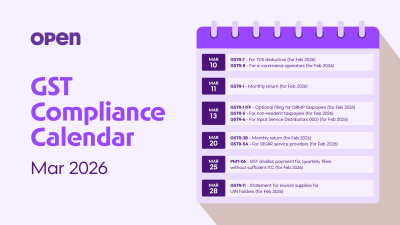
Timely filing is fundamental to GST compliance. Every GST return has a prescribed due date, and missing these deadlines is one of the most common mistakes in GST that leads to tax notices.
Key deadlines businesses must track
- GSTR-1: Outward supplies return, generally due by the 11th of the following month for monthly filers, or filed quarterly under the QRMP scheme.
- GSTR-3B: Summary return, typically due between the 20th and 24th of the following month, depending on the taxpayer category and location.
- Annual returns such as GSTR-9 have fixed deadlines after the end of the financial year.
Why late filing is serious
Late filing attracts late fees under Section 47 and interest under Section 50 of the CGST Act. Even when there is no business activity, a NIL return must be filed. Failure to file NIL returns can result in penalties, system-generated notices, and difficulties in filing subsequent returns.
How to prevent this
- Maintain a GST compliance calendar with automated reminders.
- Use filing software or engage a tax professional to track due dates.
- File NIL returns promptly when there are no transactions.
4. Errors in Invoice Details and Classification Codes
GST returns require accurate invoice-level information, including GSTIN, invoice numbers, HSN (Harmonised System of Nomenclature) or SAC (Service Accounting Codes), taxable values, and applicable tax rates. Errors in these details are fairly common and often trigger GST notices.
Common invoice errors
- Incorrect GSTINs or invoice numbers.
- Use of wrong or outdated HSN/SAC codes, leading to incorrect tax rate application.
- Reporting inter-state supplies under the wrong tax category, such as CGST and SGST instead of IGST.
Why this causes issues
Incorrect invoice details can result in mismatches across returns. For instance, recipients may be unable to claim ITC if the supplier’s invoice data does not match their records. Errors in HSN or SAC classification can also lead to scrutiny, differential tax demands, interest, and in some cases, penalties.
How to avoid these errors
- Verify GSTINs, invoice numbers, and dates before filing returns.
- Refer to updated HSN and SAC codes and confirm applicable tax rates regularly.
- Train billing and accounts teams on proper invoice preparation and data entry standards.
5. Poor Record-Keeping and Documentation
Maintaining proper records is an essential but often overlooked part of GST compliance. Poor documentation leads to mistakes and increases the likelihood of notices during assessments or audits.
Typical record-keeping issues
- Lost or incomplete invoices.
- Unorganised purchase records affecting ITC claims.
- Missing supporting documents for zero-rated or exempt supplies.
Impact of inadequate records
Without clear documentation, reconciling returns becomes difficult. This can cause mismatches and compliance gaps that are noticed during department assessments. Notices may ask for justification of entries or supporting evidence, which becomes challenging with disorganised records.
How to improve documentation
- Maintain a systematic digital filing system for all GST invoices.
- Ensure every invoice is backed by related documents such as e-way bills where applicable.
- Regularly back up electronic records and maintain physical copies as needed.
Conclusion
Avoiding tax notices starts with understanding common mistakes in gst that are prevalent in daily compliance. Mismatches between returns, incorrect ITC claims, missed deadlines, errors in invoice details, and poor documentation are among the most frequent triggers. By adopting a disciplined approach to reconciliation, automation where possible, and regular review of GST data, businesses can significantly reduce the risk of notices.
GST compliance is not only about filing on time. It is also about ensuring the accuracy and completeness of every return filed. With careful planning and the right processes, GST filing can become a routine activity that supports business continuity rather than inviting regulatory scrutiny.