
Key Takeaways
- The CFO role has expanded beyond financial reporting — today’s finance leaders are expected to shape strategy, lead digital transformation, and manage enterprise-wide risk.
- Enterprise control is not about restricting growth — it’s about embedding governance into systems so that scale creates leverage, not exposure.
- Modern CFOs must shift from historical reporting to forward looking insight, boards expect scenario modeling and liquidity forecasting, not just accurate closing numbers.
- AI strengthens forecasting and risk detection, but must operate within defined approval hierarchies and structured controls — ungoverned automation amplifies risk rather than reducing it.
For decades, the CFO was defined by precision.
Close the books.
Protect capital.
Report performance.
Those fundamentals still matter. But they are no longer enough. The evolving role of CFO reflects a deeper structural shift in how businesses operate. Finance leaders today are expected to influence enterprise strategy, guide digital transformation, manage multidimensional risk, and ensure that growth does not come at the cost of control.
The CFO is no longer just responsible for financial accuracy. They are responsible for enterprise clarity. And that distinction changes everything.
Why the CFO Role Is Expanding
The transformation of the CFO role is not theoretical. It is being driven by real structural pressures:
- Rapid digital adoption across industries
- Increasing regulatory and governance scrutiny
- Fragmented finance systems and tech stacks
- Demand for real-time, forward-looking insight
- Tighter margins and capital discipline
In this environment, reporting what happened last quarter is table stakes. Boards, investors, and CEOs want foresight. They want risk visibility. They want decision support that integrates operations, technology, and finance.
This is where the modern CFO’s responsibilities begin to expand beyond traditional accounting oversight. Finance is no longer downstream from strategy. It is embedded inside it.
The Shift from Financial Steward to Enterprise Leader
Historically, the CFO was viewed as the financial gatekeeper — the executive who validated numbers and safeguarded resources.
Today, the CFO’s strategic role is far more integrated.
Modern CFOs:
- Shape capital allocation decisions
- Evaluate expansion strategies
- Lead cost transformation initiatives
- Partner on pricing and margin optimization
- Influence digital investment priorities
They do not simply measure performance. They shape it. This elevation requires a different mindset. Instead of asking, “Are the numbers accurate?” the modern CFO asks, “Are our systems, processes, and controls strong enough to support sustainable growth?”
That question leads directly to the idea of enterprise control.
Enterprise Control: The Defining Mandate of Modern Finance
Enterprise control is not about restricting growth. It is about enabling confident growth.
In a fragmented finance environment — where approvals live in email threads, payments move through separate banking portals, and reconciliations happen in spreadsheets — control becomes reactive. Issues are discovered after damage occurs.
In an integrated environment, control becomes embedded. Governance is built into workflows. Visibility is real-time. Errors are prevented, not corrected.
The evolving role of CFO increasingly centers on designing this controlled environment.
Enterprise control includes:
- Enforceable approval hierarchies
- Verified vendor onboarding
- Audit-ready documentation
- Real-time cash visibility
- Automated reconciliation
- Standardized financial data flows
This is not operational housekeeping. It is a strategic infrastructure. Without control, scale creates risk. With control, scale creates leverage.
Modern CFO Responsibilities in 2026
To understand the future of the CFO role, it helps to look at how responsibilities are expanding in practical terms.
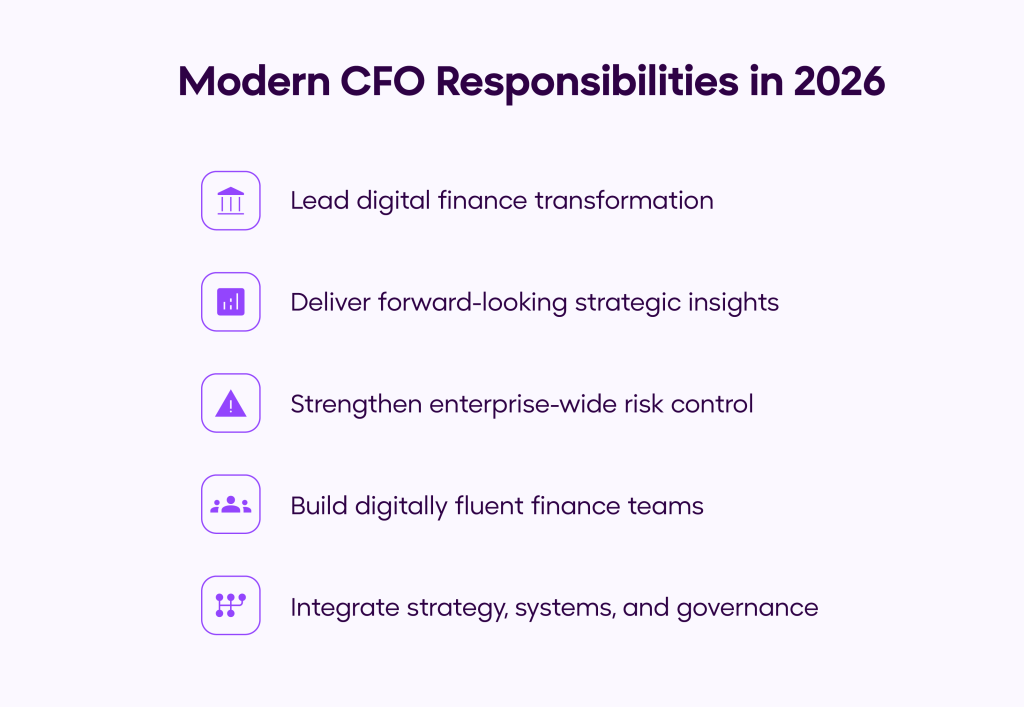
1. Leading Digital Finance Transformation
CFO digital transformation is no longer an optional modernization initiative. It is a strategic imperative.
Finance leaders are now responsible for:
- Replacing manual processes with automation
- Integrating ERP, banking, and workflow systems
- Enabling real-time dashboards and analytics
- Eliminating data silos across business units
Digital transformation in finance is not about adding more software. It is about ensuring systems communicate seamlessly and generate a single source of truth.
When infrastructure is fragmented, finance teams spend time reconciling inconsistencies. When it is unified, they spend time analyzing insights. That shift fundamentally elevates the CFO’s influence.
Increasingly, transformation also includes the responsible adoption of artificial intelligence. AI-powered reconciliation tools, anomaly detection systems, and intelligent workflow automation reduce manual intervention while strengthening control.
Rather than replacing finance expertise, AI enhances it. It frees teams from repetitive validation so they can focus on analysis, scenario modeling, and strategic guidance.
For the modern CFO, the priority is not merely adopting AI — it is governing it. Intelligent systems must operate within defined approval hierarchies, documented workflows, and enforceable controls.
2. Delivering Forward-Looking Insights
One of the most important CFO responsibilities is shifting from historical reporting to predictive insight. Accuracy is assumed. Anticipation is expected.
Boards increasingly look to the CFO for:
- Scenario modeling under economic volatility
- Liquidity forecasting across entities
- Working capital optimization
- Margin sensitivity analysis
The CFO’s value is no longer measured solely by how precisely the last quarter was reported. It is measured by how clearly the next quarter is understood.
Today’s finance function must answer not only “What happened?” but “What happens if demand drops 10%?” or “How does this investment impact cash in 18 months?”
That ability to model outcomes before they materialize defines the future of the CFO role.
Artificial intelligence is accelerating this capability. AI-driven models can identify emerging liquidity pressures, detect patterns across large financial datasets, and simulate complex scenarios in real time.
Instead of relying on static forecasting cycles, finance leaders can move toward continuous intelligence — where data signals are analyzed dynamically and insights surface proactively.
In this environment, AI does not replace judgment. It amplifies it. The CFO remains the decision authority, now equipped with sharper foresight and deeper analytical depth.
Finance evolves from a reporting function into a strategic decision engine — guiding capital allocation, risk management, and growth with confidence.
3. Managing Interconnected Risk
Risk today is layered, interconnected, and fast-moving. It no longer sits neatly within compliance checklists or fraud reports.
The modern CFO must oversee:
- Financial risk
- Operational disruption risk
- Cyber and digital exposure
- Regulatory and governance obligations
- Vendor and payment integrity risk
What makes this shift significant is not just the breadth of risk, but its velocity. In digitally connected environments, issues escalate quickly. A vendor data error or workflow gap can ripple across systems in minutes.
Modern CFO responsibilities, therefore, include designing risk frameworks that embed control directly into systems — not merely documenting policies after the fact. Governance must be enforceable, traceable, and automated wherever possible.
Payment workflows, for example, should not rely on memory, emails, or manual cross-checks. They should incorporate structured approvals, beneficiary validation, and system-level safeguards that prevent incorrect payouts before they occur.
This marks the shift from reactive oversight to structural prevention.
AI further strengthens this model. Intelligent monitoring systems can flag irregular payment patterns, detect duplicate invoices, and identify outlier transactions before funds leave the organization.
However, AI must operate within governed systems. Without defined approval workflows and structured controls, automation can amplify risk rather than reduce it.
The CFO’s role is to ensure intelligent systems enhance enterprise control — not bypass it.
And that responsibility is central to finance leadership in an age where risk travels at digital speed.
4. Building Digitally Fluent Finance Teams
Technology alone does not transform finance. Capability does.
As finance becomes increasingly digital, the CFO must ensure the function evolves alongside the tools it adopts. Automation, analytics platforms, and integrated systems require teams that understand not only accounting principles, but also data interpretation, process architecture, and system logic.
This expands the CFO’s mandate into talent strategy.
It involves redefining hiring criteria, investing in continuous upskilling, and fostering structured collaboration between finance, IT, and operations.
The modern CFO is not only responsible for financial outcomes. They are responsible for building a finance organization capable of thriving within a digitally integrated environment.
That capability is what sustains transformation long after systems are implemented.
5. Acting as Enterprise Integrator
One of the most defining shifts in the evolving role of the CFO is integration.
Today’s CFO operates at the intersection of:
- Strategy
- Technology
- Operations
- Compliance
- Capital markets
This position requires more than financial oversight. It requires alignment.
The CFO translates strategic ambition into financially sustainable execution. They ensure systems scale alongside growth, governance evolves with expansion, and operational decisions remain grounded in financial reality.
In practical terms, this means connecting data across functions, aligning digital investments with enterprise priorities, and embedding controls that enable innovation without introducing instability.
The CFO is no longer the final checkpoint in the information flow. They are the architect of how financial intelligence moves across the organization — shaping decisions before they are made, not merely validating them afterward.
How OPEN Enables CFOs to Operationalize Enterprise Control
For CFOs to lead effectively, they need infrastructure that supports enforcement — not just visibility.
OPEN strengthens the enterprise control mandate by connecting workflows, approvals, and payments into a unified environment.
Instead of fragmented systems across banking portals, spreadsheets, and disconnected tools, finance leaders gain structured governance across the entire payables lifecycle.
With OPEN, CFOs can:
- Ensure approvals are enforceable before payments are released
- Centralize payment workflows and audit trails
- Gain real-time visibility into outflows and cash positioning
- Reduce manual reconciliation effort
- Strengthen compliance through built-in process controls
Rather than layering more tools onto an already complex stack, OPEN consolidates critical financial workflows into a controlled, connected system.
The result is not just efficiency — it is confidence.
Confidence that payments are validated.
Confidence that approvals are documented.
Confidence that financial data reflects operational reality.
In the age of enterprise control, that confidence becomes a strategic advantage.
The Future of the CFO Role: Strategic Authority Backed by Systems
The CFO of the future will not be defined by reporting frequency or cost control alone.
They will be defined by:
- The strength of their digital infrastructure
- The clarity of their data
- The enforceability of their controls
- The quality of their forward-looking insight
- Their ability to govern and leverage AI responsibly
Artificial intelligence will increasingly shape forecasting, risk detection, and financial operations. Its impact, however, will depend on governance, transparency, and integration.
In the age of enterprise control, AI must function within structured systems — not as an isolated layer of automation.
The evolving role of the CFO is not about abandoning financial discipline. It is about elevating it — embedding discipline directly into systems so that growth, governance, and innovation move in alignment.
Finance no longer operates in the background. It operates at the center.
And in the age of enterprise control, the CFO is not just tracking value creation. They are engineering it.
Ready to strengthen enterprise control and modernize your finance operations?
FAQs
1. What are the top 5 roles of a CFO?
The top five roles of a CFO include:
- Strategic business partner
- Financial steward
- Enterprise risk manager
- Digital transformation leader
- Stakeholder communicator
These roles reflect the evolving role of the CFO from traditional reporting oversight to enterprise-wide leadership.
2. How has the CFO’s strategic role changed?
The CFO’s strategic role has expanded from financial oversight to influencing growth, capital allocation, and digital investment decisions. CFOs now shape business direction rather than simply measure performance.
3. Why is digital transformation important for CFOs?
CFO digital transformation enables automation, real-time visibility, and stronger controls. Integrated systems reduce risk, improve forecasting, and support better strategic decision-making.
4. What are the top priorities of a CFO?
CFO priorities begin with safeguarding liquidity, maintaining compliance, managing financial and operational risk, and ensuring accurate reporting.