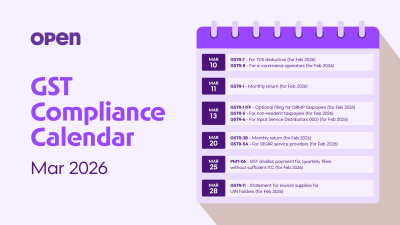


If your enterprise processes 1M+ invoices, GST compliance stops being a “returns” problem and becomes a data engineering + controls problem.
At this scale, even small issues compound fast:
- A tiny master-data mismatch becomes thousands of reconciliation exceptions.
- A naming convention that “mostly works” turns into duplicate invoice errors.
- A late supplier upload can shift input tax credit visibility to the next cycle, affecting cash flow planning.
And the compliance bar is getting tighter. For example, GSTR-2B is generated on the 14th of the succeeding month (static statement) – which means your month-end ITC picture has a hard “snapshot” behavior built in. Also, GST systems are moving toward hard-locking auto-populated liabilities in GSTR-3B, pushing teams to correct upstream (GSTR-1/GSTR-1A/IFF) rather than “fixing it in 3B.”
So what does “high-volume GST filing” look like when invoice volumes cross seven digits? Let’s break down the real challenges and the patterns that make enterprise-grade filing reliable.
High-volume GST filing isn’t a portal activity — it’s a pipeline
Most enterprise teams don’t struggle because they don’t know GST rules. They struggle because the inputs don’t behave like clean inputs.
At 1M+ invoices, your GST pipeline is typically fed by:
- Multiple ERPs and instances (business units, plants, acquisitions)
- Billing platforms + POS systems
- Vendor invoices coming through email/PDF + e-invoices
- Logistics and returns systems (credit notes/debit notes)
- Manual “exception” entries that bypass standard flows
The GST portal supports offline/third-party routes for invoice data preparation and upload (including GSTR-1 using offline tools or via ASP/GSP integrations). But the portal path is only the last mile. The real work is upstream: standardization, validation, deduplication, and auditability.
Large-scale invoice processing: why the “same invoice” isn’t the same
In large organizations, “invoice identity” breaks in predictable ways:
Duplicate-looking invoices (that are not duplicates)
- Same invoice number across branches because the numbering wasn’t designed for a multi-entity scale
- Legacy systems that reset sequences per month
- Reissued invoices after cancellation with near-identical references
Truly duplicate invoices (that sneak through)
- Same invoice ingested twice from two channels (API + manual upload, email + ERP sync)
- Credit note linked incorrectly and treated as a fresh invoice
- Partial posting events creating multiple “versions” of the same transaction
GST rules around invoice number constraints also matter operationally: invoice numbers have constraints (e.g., max length and allowed characters), so data cleanup often becomes mandatory, not optional.
Enterprise pattern that works: define a canonical invoice key that is stable across systems (not just invoice number). Typically it’s a composite of supplier GSTIN + invoice number + invoice date + document type + place of supply (or equivalent control fields). Then enforce idempotency: the same key should never create two tax documents in your GST layer.
Reconciliation is where volume hurts the most (and where automation wins)
Most leaders think reconciliation is “matching invoices.” In practice, it’s matching representations of invoices across three worlds:
- Your books/purchase register
- Supplier outward filings (GSTR-1/IFF) that flow into your visibility
- Your ITC eligibility snapshot (GSTR-2B)
And those worlds don’t update at the same speed.
GSTR-2B is a monthly snapshot — plan your closing around it
GST portal guidance makes it clear: GSTR-2B is generated on the 14th of the succeeding month. So your ITC picture is inherently “as-of” a date. If your internal close expects real-time completeness without respecting this cadence, you’ll keep fighting the same fires.
Hard-locking makes upstream accuracy non-negotiable
GST advisories have shifted to non-editable auto-populated liability in GSTR-3B (based on outward supplies declared in GSTR-1/GSTR-1A/IFF), reinforcing the need to catch issues earlier in the chain.
Enterprise takeaway: reconciliation isn’t a month-end task. It’s a continuous control that reduces the delta you carry into the 14th/20th deadlines.
That’s exactly why “GST reconciliation automation” matters: it’s less about speed and more about consistency at scale.
E-invoicing helps, but it doesn’t remove enterprise complexity
For many large taxpayers, e-invoicing is a major input stream. There are two implications that matter operationally:
- E-invoice data can flow into GSTR-1 tables (auto-population)
This reduces manual outward supply preparation, but you still need governance over cancellations, amendments, and non-einvoice supplies. - Time-bound reporting expectations
For businesses above the specified turnover thresholds, GSTN has communicated a time limit for reporting e-invoices to the IRP (for certain taxpayers, within a set number of days from invoice date). When invoice volume is huge, these time-bound expectations turn into workflow design constraints: ingestion delays are no longer “admin issues.” They become compliance exposure.
Enterprise data management: the hidden lever behind “clean GST filing”
When enterprises say they want “enterprise GST filing,” what they actually need is enterprise data management purpose-built for GST.
Here are the components that separate stable compliance from constant escalations:
A single “GST-ready” data layer (not scattered extracts)
You want one governed layer that standardizes:
- GSTIN mapping (supplier/customer/site)
- HSN/SAC normalization
- Tax rate and place-of-supply logic
- Document type rules (invoice, DN/CN, amendments, exports, SEZ, etc.)
Validation before upload (schema + business checks)
High-volume uploads fail for reasons that are boring but deadly at scale:
- Missing mandatory fields
- Format and length violations
- Duplicate invoice conditions
- Tax mismatch logic errors
If you’ve ever dealt with “processed with error” JSON outcomes, you know how costly rework becomes when files contain thousands of records.
Partitioning + parallelism (because 1M is not “a large Excel”)
A practical approach is to partition by:
- GSTIN/registration
- month + document type
- business unit or state
- and sometimes by counterparty buckets
Then run validations and reconciliations in parallel, with clear audit logs.
Auditability built in
Enterprises don’t just need correct numbers. They need to answer:
- “Where did this number come from?”
- “Who changed it?”
- “Which source document supports it?”
- “What was the exception decision and why?”
This is where tools and systems must behave like controls, not just utilities.
A pragmatic playbook for 1M+ invoice GST operations
If you’re building or fixing the engine, this sequence works well:
- Standardize master data first
Clean vendor/customer GSTIN mapping, site registrations, tax jurisdictions, and HSN libraries. - Define canonical document identity
Prevent duplicates by design, not by detection after upload. - Shift-left validations
Catch format/rule issues before files hit the portal or GSP layer. - Automate reconciliation as a continuous loop
Don’t wait for the month-end. Reconcile daily/weekly so the 14th is a confirmation, not a surprise. - Design for corrections upstream
With increasing system enforcement around auto-populated liabilities, treat upstream amendment windows as part of the process, not an exception path. - Track exceptions like a product
Build dashboards by reason code: missing supplier filing, GSTIN mismatch, invoice number format, tax rate mismatch, partial match, duplicates, etc. Then fix root causes.
For enterprises, the real goal isn’t “file faster.” It’s file with control:
- predictable reconciliation outcomes,
- fewer last-minute adjustments,
- cleaner audit trails,
- and a compliance process that scales with business volume.
Platforms built for GST operations (including reconciliation and exception workflows) can take the repetitive work off your team’s plate 0 not by replacing expertise, but by making expertise scalable.
If you’re evaluating GST reconciliation automation and enterprise-grade workflows, anchor your evaluation on the essentials: data standardization, validation depth, reconciliation logic, and auditability. The rest is UI.
Closing thought
At 1M+ invoices, GST compliance becomes less about filing a return and more about building a trustworthy invoice-to-return system. Once that system is in place, deadlines feel less dramatic, reconciliation becomes explainable, and your team spends more time on decisions and not firefighting.