
Key Takeaways
- Compliance is a continuous cycle: With the rise of e-invoicing and real-time data matching, GST compliance has evolved from a month-end filing chore into an ongoing, daily tracking process.
- Scale demands more than just filing tools: Enterprises operating across multiple states need software that provides a consolidated, PAN-level view of all GSTINs to maintain control and visibility.
- Automated reconciliation is non-negotiable: Manually matching purchase data with GSTR-2A/2B is a massive drain on resources; modern platforms automate this to secure your eligible Input Tax Credit (ITC).
- End-to-end control with Optotax: The best enterprise solutions go beyond basic returns to offer seamless ERP integration, automated mismatch flagging, and audit-ready reporting in one unified workflow.
GST compliance is no longer limited to filing returns at the end of the month. For enterprises managing large transaction volumes and multiple GSTINs, it has become an ongoing process involving invoice validation, reconciliation with GSTR-2B, and continuous tracking of input tax credit (ITC).
With the introduction of e-invoicing and increasing data matching by GST systems, errors and mismatches are identified much earlier. This makes it important for businesses to stay on top of their data throughout the month, rather than only at the time of filing.
As a result, adopting the best GST compliance software has become essential. The right GST software for enterprises goes beyond return filing. It helps automate reconciliation, improves data visibility, and supports teams in maintaining accurate and audit-ready records.
In this blog, we look at what enterprises should expect from modern solutions and the leading options available today.
What Enterprises Should Look for in GST Software
Choosing the right platform starts with understanding what enterprise-grade compliance requires.
1. Multi-GSTIN Management
Enterprises often operate across multiple states. A good system should enable seamless management of multiple GSTINs with a consolidated, PAN-level view for better control and visibility.
2. Automated Reconciliation
Reconciling purchase data with GSTR-2A and GSTR-2B is one of the most time-intensive tasks. Modern GST automation software helps automate invoice matching, flag missing or mismatched entries, and improve the accuracy of the eligible input tax credit (ITC).
3. ERP Integration
Most enterprises rely on ERP systems. GST software should integrate smoothly with these systems to ensure real-time data flow, reduce duplication, and minimise manual intervention.
4. Regulatory Readiness
With frequent updates in GST rules, including e-invoicing requirements and ongoing return validations, software must stay aligned with the latest compliance needs without disrupting existing workflows.
5. Reporting and Audit Support
Detailed reports, validation checks, and audit trails are essential for internal reviews. Enterprises benefit from clear visibility into ITC, reconciliation status, and exceptions, helping teams stay prepared for audits and compliance checks.
Best GST Compliance Software for Enterprises (2026)
The tools below represent commonly used approaches to GST compliance, ranging from filing-focused solutions to platforms designed for enterprise-scale reconciliation and control.
OPTOTAX (Built for Enterprise-Scale GST Control)
OPTOTAX is designed for enterprises and tax teams that need end-to-end visibility and control across complex GST workflows.
Instead of treating compliance as a filing task, it enables businesses to manage reconciliation, reporting, and audit readiness within a single system.
It is particularly suited for organisations where reconciliation accuracy, multi-GSTIN visibility, and audit readiness are critical.
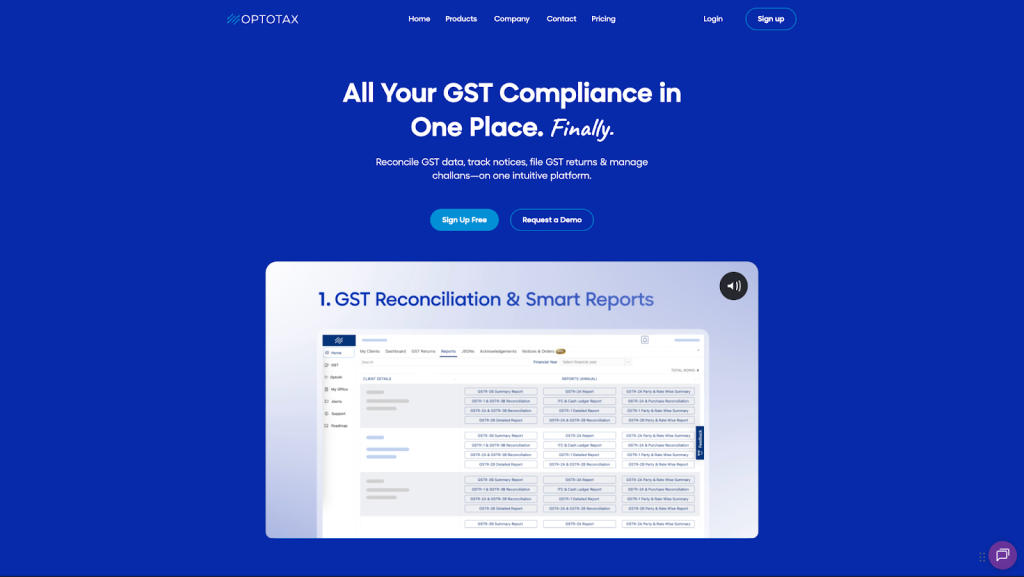
Key features:
- Comprehensive GST workflows
Supports key stages of compliance, from data preparation to reconciliation and return readiness within a single platform. - Reconciliation support
Helps teams match data across books and GSTR-2A/2B, making it easier to identify mismatches and follow up where needed. - Multi-GSTIN visibility
A unified view to monitor multiple registrations without switching between systems. - Scalable data handling
Suitable for businesses dealing with high invoice volumes. - Structured reporting
Reports that support ITC tracking, mismatch identification, and audit preparation.
OPTOTAX is well-suited for enterprises looking for a balance between automation and operational control without adding unnecessary complexity.
Explore how OPTOTAX can simplify your GST compliance workflows and bring greater clarity to your enterprise operations.
ClearTax GST
ClearTax is commonly used for GST return filing and compliance workflows, particularly by teams focused on automation and ease of use.
Key features:
- PAN-level filing across returns including GSTR-1, GSTR-3B, and annual returns
- Automated reconciliation designed to handle large volumes of invoice data
- Built-in validations to identify errors before filing
- Integration with ERP systems
- Direct connectivity with GST systems through GSP infrastructure
TallyPrime
TallyPrime is a familiar choice for businesses that want GST compliance integrated with their accounting system. For enterprises, it is often used alongside other tools when additional reconciliation or automation is required.
Key features:
- GST-ready accounting with return preparation
- Support for e-invoicing and e-way bill generation
- Simple workflows for finance teams
- Wide adoption across businesses
Zoho Books
Zoho Books combines accounting and GST compliance in a single platform. It works well for businesses that prefer an integrated approach to accounting and GST filing software India, especially when combined with supporting compliance tools.
Key features:
- GST-compliant invoicing with support for tax rates and reporting
- Automated workflows for routine tasks
- Integration with the broader Zoho ecosystem
- Real-time financial tracking and reporting
Mysa
Mysa is positioned as a reconciliation-focused platform, offering tools for invoice matching and discrepancy tracking across GST data. Such platforms can be useful for businesses looking to improve visibility into reconciliation workflows.
Key features:
- Invoice matching support using rule-based and pattern-driven logic
- Multi-GSTIN dashboards for better visibility
- Discrepancy tracking and reporting
- Integration support with enterprise systems
How to Choose the Right GST Software
The right choice depends on how your business operates and where your current challenges lie.
- If your priority is simplifying compliance while maintaining better control over processes, look for software that offers structured workflows and clear visibility across GST activities.
- If you deal with high transaction volumes, choose a solution that can handle large datasets efficiently and offers strong automation for reconciliation and validations.
- If your workflows are closely tied to accounting systems, consider tools that integrate seamlessly with your existing setup to avoid duplication and manual effort.
The goal is to choose a GST software for enterprises that fits into your existing processes, rather than requiring your team to adapt to a completely new way of working.
Ultimately, the right solution comes down to what matters most to your business, whether it is faster and smoother filing, seamless integration with your accounting systems, or complete end-to-end compliance control as you scale.
Final Thoughts
GST compliance is becoming more data-intensive with every update. Enterprises that rely heavily on manual processes often face delays, reconciliation gaps, and increased compliance risks.
Modern GST automation software helps shift the approach from reactive filing to proactive compliance. It enables better visibility, faster reconciliation, and more accurate ITC claims.
Choosing the best GST compliance software is not just about features. It is about finding a solution that aligns with your scale, integrates with your systems, and supports your team in managing compliance efficiently.
For enterprises aiming to streamline their GST processes without overcomplicating them, solutions like OPTOTAX offer a practical and structured approach to compliance.
FAQs (Frequently Asked Questions)
1. What is the best GST compliance software for enterprises?
The best GST compliance software for enterprises is one that can handle large transaction volumes, support multiple GSTINs, automate reconciliation, and support return preparation. It should also integrate with existing systems and provide clear reporting for better compliance management.
2. Why do enterprises need GST automation software?
GST automation software helps enterprises reduce manual effort in tasks like reconciliation, validation, and reporting. It improves accuracy, saves time, and enables teams to identify mismatches early, reducing compliance risks.
3. Can GST software handle multiple GSTINs?
Yes, most enterprise-grade solutions are designed to manage multiple GSTINs from a single platform. This allows businesses to consolidate data, track filings, and monitor compliance across locations more efficiently.
4. What should businesses consider before choosing GST software?
Businesses should evaluate factors such as scalability, ease of integration with existing systems, level of automation, and reporting capabilities. The right GST software for enterprises should align with existing workflows and simplify compliance without adding complexity.