
Key Takeaways
- Manual processes don’t scale: High invoice volumes expose the flaws in fragmented, manual workflows and create serious compliance gaps.
- AI creates living audit trails: Instead of static, after the fact logs, AI automatically records the context of every validation, match, and approval in real time.
- Audit-ready GST compliance: Critical regulatory checks—like GSTIN verification and PAN validation are embedded directly into the workflow.
- Proactive fraud detection: Automated systems continuously monitor the invoice lifecycle to catch anomalies and duplicate payments before money leaves the bank.
Why are internal controls becoming harder to maintain?
For most finance teams, internal controls in accounts payable were designed for a very different operating environment.
Invoice volumes were smaller, vendor networks were manageable, and approvals moved through clearly defined hierarchies. Maintaining an audit trail often meant keeping transaction records, approval emails, and reconciliation spreadsheets that could be assembled when auditors asked for them.
Today, that environment has changed dramatically.
Finance teams now process thousands of invoices each month, often across multiple entities, business units, and compliance requirements. Vendor onboarding, GST validation, purchase order matching, approval routing, and payment reconciliation frequently happen across different systems. The result is a fragmented control environment where reconstructing the history of a transaction can take hours—or even days.
As invoice volumes increase and regulatory scrutiny intensifies, maintaining reliable internal controls through manual documentation becomes increasingly difficult.
This is where AI-powered audit trails are beginning to reshape the way finance teams manage compliance, transparency, and governance within accounts payable.
What an automated audit trail in accounts payable looks like
A traditional audit trail is essentially a log of transactions recorded after events occur. While useful, these records often lack the context needed to understand how a decision was made or whether appropriate controls were followed.
An AI-powered audit trail functions differently. Instead of capturing events retrospectively, it creates a continuous, system-generated record of every action across the invoice-to-pay lifecycle.
As invoices move through capture, validation, approval, and payment, the system automatically records who performed each action, what data was processed, what rules were triggered, and when the decision occurred.
The result is a living operational record rather than a static log. Finance teams and auditors can trace the full history of an invoice—from receipt to payment—without relying on manual documentation or fragmented records.
How AI Agents Build and Maintain Audit Trails in AP
Modern AI-driven AP platforms generate audit documentation automatically across every stage of the invoice lifecycle. Instead of relying on manual record-keeping, AI agents capture the operational context of each transaction as it moves through the workflow.
This includes several layers of documentation:
1. Invoice capture and extraction logging
When an invoice enters the system—via email, upload, or vendor portal—the system records the receipt event, including the document source and timestamp. Data extracted from the invoice is logged alongside confidence scores and original document references.
2. Data validation and three-way matching records
AI systems validate invoice data against purchase orders and goods receipt notes. The audit trail documents whether the match was successful, which records were used, and any discrepancies that triggered tolerance thresholds.
3. Approval workflow documentation
Each step in the approval chain is captured automatically. The system records who reviewed the invoice, when the decision was made, and whether any escalations occurred.
4. Compliance validation records
For Indian businesses, this includes checks such as GSTIN verification, PAN validation, and vendor master data confirmation. The results of these validations become part of the permanent audit record.
5. Exception and anomaly detection
When the system detects unusual patterns—such as duplicate invoices or abnormal pricing—the detection event is logged with the rule or model that triggered it and the action taken.
6. Payment and reconciliation tracking
Once payment is approved, the audit trail extends to include payment instructions, bank references, and reconciliation status, creating a complete record from invoice receipt to settlement.
Together, these layers form a connected audit trail that documents the entire invoice-to-pay process.
Why Automated Audit Trails Matter for Indian Finance Teams
An automated audit trail in AP for India is particularly significant because of the regulatory environment. It helps finance teams stay audit-ready while handling GST compliance, vendor documentation, and approval tracking.”
Finance teams must maintain detailed documentation to support compliance requirements across multiple frameworks, including GST reporting, input tax credit eligibility, vendor KYC verification, and tax audits.
When documentation is fragmented or incomplete, organisations often face several operational risks:
- ITC disallowance due to GST mismatches
- Delayed responses during statutory audits
- Difficulty demonstrating approval controls
- Increased exposure to duplicate or fraudulent payments
AI-powered accounts payable systems address these challenges by embedding compliance documentation directly into the operational workflow. Every validation, approval, and exception becomes part of the audit record automatically.
Instead of assembling documentation reactively during an audit, finance teams maintain a continuously updated compliance record in real time.
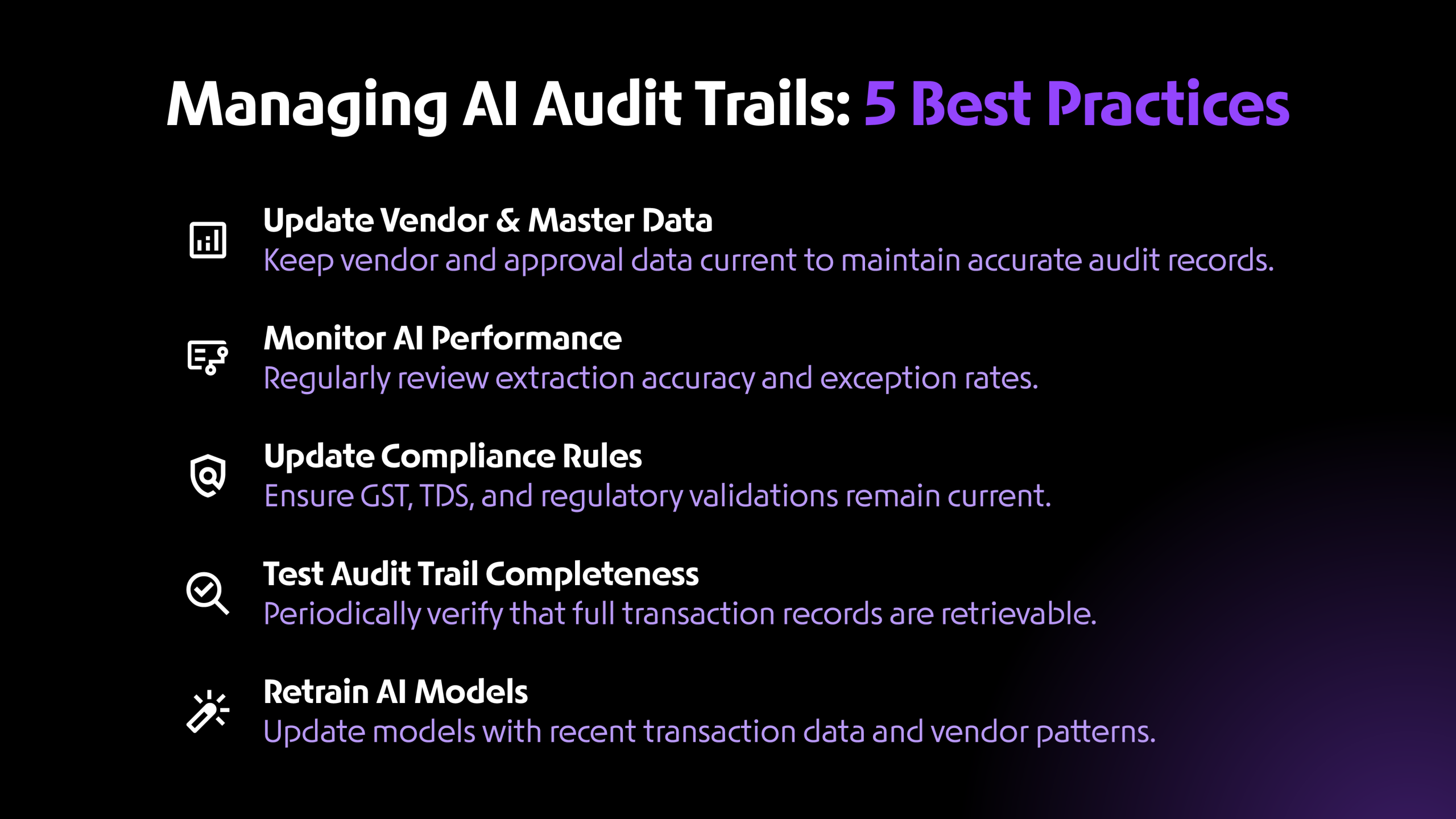
Best Practices for AI Audit Trails
As finance teams move toward AI-powered audit trails, implementation discipline becomes critical. The value of automation is not just in capturing data, but in ensuring that audit records remain accurate, complete, and aligned with evolving compliance requirements.
Leading finance teams treat audit trails as a continuously managed system, not a one-time setup. The following best practices help ensure that AI-driven audit trails remain reliable, audit-ready, and operationally effective at scale.
What Finance Teams Should Look for in AP Automation Software
When evaluating accounts payable tools India vendors offer, audit trail capability should be a central criterion. Finance leaders should look for:
End-to-end invoice lifecycle tracking — the system should capture the full journey from receipt to payment without relying on external systems or manual logs.
Structured approval workflow documentation — approval chains clearly recorded with timestamps, user identities, and escalation records.
Compliance validation logging — GSTIN, PAN, and tax validations are documented automatically within the audit trail, not as a separate report.
Intelligent exception handling — AI models that flag unusual patterns such as duplicate invoices or abnormal pricing, with the detection logic itself logged.
Searchable and exportable audit records — finance teams should retrieve documentation instantly during audits without manual compilation.
India-specific compliance coverage — ITC documentation, GST audit readiness, and vendor KYC evidence built into the standard audit record.
Together, these capabilities ensure the audit trail functions not just as a record of transactions but as a core component of the organisation’s internal control framework.
How OPEN Enables AI-Powered Audit Trails
One of the persistent challenges in accounts payable is the fragmentation of operational data. Invoice capture, approvals, vendor records, and payment execution often exist across separate systems, making it difficult to maintain a reliable audit record.
OPEN addresses this by bringing the entire invoice-to-pay process together within a unified accounts payable platform.
Invoices captured through OCR are automatically logged with extraction details. Three-way matching between invoices, purchase orders, and goods receipt notes creates a documented validation layer. Structured approval workflows ensure every review and decision is recorded, while vendor onboarding integrates GSTIN and PAN verification directly into the compliance audit trail.
With payment execution connected directly to the AP workflow, finance teams gain a continuous audit trail spanning invoice receipt, approval, and settlement.
For mid-market organisations evaluating AP automation solutions, this integrated approach provides the transparency required to maintain strong financial controls.
Predictions: The Future of AI in Auditing
AI audit trails are evolving rapidly, and several developments are likely to shape the next phase of financial governance.
Predictive auditing
AI systems will increasingly analyse historical transaction patterns to identify vendors, invoice categories, or approval pathways that carry elevated risk before issues occur.
Continuous compliance monitoring
Rather than periodic audits, organisations will move toward real-time monitoring of financial controls embedded directly within operational systems.
Integrated financial governance
Audit trails will connect accounts payable data with broader compliance platforms, including ERP systems, tax reporting tools, and regulatory dashboards.
AI-generated audit documentation
Generative AI will increasingly convert raw audit logs into structured audit reports, approval narratives, and compliance summaries automatically.
Executive-level visibility
Finance leaders will gain real-time dashboards that highlight control effectiveness, exception trends, and audit readiness across the AP function.
These developments signal a shift toward continuous financial governance, where internal controls operate directly within operational systems rather than through manual documentation.
Final Thoughts
AI-powered audit trails represent a meaningful upgrade in how finance teams manage internal controls within accounts payable.
By capturing every action across the invoice-to-pay lifecycle automatically, these systems provide a level of transparency and traceability that manual documentation cannot achieve.
For Indian finance teams navigating growing invoice volumes, increasing regulatory scrutiny, and complex vendor ecosystems, automated audit trails deliver several clear benefits:
- stronger fraud detection and duplicate payment prevention
- real-time visibility into invoice approvals and exceptions
- embedded compliance documentation for GST and tax audits
- significantly faster audit preparation
As organisations evaluate modern accounts payable platforms, the ability to maintain a continuous, reliable audit trail will increasingly define the difference between basic automation and truly intelligent financial operations.
Finance teams that adopt these capabilities today will not only streamline AP processes—they will also strengthen the control infrastructure that supports long-term growth.
Platforms like OPEN AP help finance teams implement these capabilities through AI-driven workflows and integrated financial controls.
Schedule a demo to see how OPEN AP can modernise your accounts payable operations!
FAQs
What is an automated audit trail in accounts payable?
An automated audit trail is a system-generated record of every step in the invoice process — from invoice receipt and validation to approvals and payment. Because the record is created automatically, finance teams can access it anytime without manually compiling information during audits.
How is an AI-powered audit trail different from normal system logs?
Traditional system logs simply record actions. An AI-powered audit trail connects those actions across the entire workflow, providing context around approvals, validation checks, and exceptions. This makes it much easier for auditors to understand how a transaction moved through the system.
Why are automated audit trails important for Indian finance teams?
Indian businesses must manage GST compliance, vendor documentation, and multiple regulatory checks. Automated audit trails capture these validations during invoice processing, ensuring finance teams always have clear documentation ready for audits and compliance reviews.
How do AI audit trails help prevent fraud?
AI-powered systems continuously monitor transactions and flag unusual patterns such as duplicate invoices, unexpected vendor changes, or abnormal approval behaviour. This allows finance teams to catch potential fraud risks before payments are processed.
What should CFOs look for in AP software audit trails?
Finance leaders should ensure the software records every transaction step, logs compliance checks, and allows easy retrieval of audit records. The best systems generate audit-ready reports instantly, reducing the effort required during financial audits.