
Tax notices are more common than ever — and if you’re working in compliance, you already know why. Under GST, system-driven checks can trigger notices like DRC-01C the moment input tax credit mismatches cross pre-defined thresholds, sometimes within days of filing.
When you’re managing large volumes of data across multiple systems and vendors, mismatches, timing gaps, and data inconsistencies are almost inevitable. The question is no longer if a notice will arrive, but whether your team is ready before it does.
Managing notices manually keeps you in a constant state of catch-up. By the time a notice lands, the discrepancy has already been flagged. That’s exactly the problem AI tax notice management solves — shifting your compliance function from reactive to preventive.
The Shift from Reactive to Preventive Compliance
For most tax teams, the traditional workflow looks familiar: a notice arrives, data is pulled from multiple systems, transactions are validated, and a response is drafted, all under a tight deadline.
It works, but it’s exhausting and leaves little room for error.
AI changes this dynamic. With tax compliance automation and AI-enabled systems, you can continuously monitor transaction data, catch inconsistencies before they escalate, and significantly reduce the chances of notices being triggered in the first place. Preventive compliance isn’t just a concept anymore — it’s becoming the new standard.
Understanding Where Notices Originate
Common Triggers for GST Notices
Sales & Returns Mismatches
Discrepancies between reported sales in GSTR-1 and actual returns filed in GSTR-3B.
ITC Inconsistencies
Claiming excess Input Tax Credit or claiming ITC that does not match GSTR-2B data.
Vendor Non-Compliance
Vendors failing to file their returns or paying taxes late, directly impacting your ITC claims.
Delayed or Incorrect Filings
Missing deadlines or filing returns with incorrect tax rates or mismatched entries.
For example, notices issued in Form DRC-01 generally relate to tax shortfalls, excess input tax credit claims, or discrepancies identified by authorities. These notices require detailed reconciliation and justification, making them resource-intensive for enterprises.
This is where reducing the likelihood of DRC-01 notices becomes critical. Avoiding such notices is far more efficient than resolving them later.
How AI Improves Notice Risk Detection
One of the strongest use cases of AI in this space is notice risk detection.
AI systems can:
- Analyze large datasets across returns, invoices, and ledgers
- Identify patterns that indicate potential compliance risks
- Flag anomalies such as duplicate claims, incorrect tax rates, or mismatched entries
- Leverage historical data and predefined rules to surface potential issues
Unlike manual reviews, which are periodic and sample-based, AI-enabled systems allow continuous monitoring across large volumes of transactions. This improves accuracy and reduces blind spots.
Simplifying Reconciliation with AI and Automation
Reconciliation is at the heart of compliance. For enterprises, this often involves handling large volumes of records across ERP systems, vendor data, and government portals.
With tax compliance automation and AI-enabled systems, reconciliation becomes:
- Faster, with automated matching of records
- More accurate, with reduced manual errors
- Scalable, even for high transaction volumes
These systems can match invoices across datasets, highlight mismatches, and suggest corrective actions based on predefined rules. This supports AI tax notice management by reducing discrepancies and lowering the manual burden on finance teams.
Strengthening Vendor Compliance Monitoring
A significant portion of tax risk can arise from vendor behavior, alongside internal errors.
AI can track vendor compliance patterns by:
- Monitoring filing status and consistency
- Identifying vendors with frequent mismatches
- Flagging high-risk vendors before transactions escalate into issues
By addressing these risks early, enterprises can reduce the risk of DRC-01 notices and avoid cascading compliance issues.
Faster, More Structured Notice Handling
Even with strong preventive systems, some notices are inevitable. AI helps here as well.
Modern AI tax notice management solutions can:
- Categorize notices based on type and severity
- Map notices to relevant transactions and documents
- Assist in drafting responses using predefined templates and historical data
- Track deadlines and ensure timely submissions
This reduces turnaround time and improves consistency in responses, which is especially important for large organizations managing multiple notices simultaneously.
Platforms like Optotax further simplify this process by centralizing notice tracking, organizing relevant data and documents, and enabling structured workflows for timely responses.
Managing multiple notices at once? Explore how Optotax can help streamline your notice management workflows and stay ahead of deadlines.
Building a Data-Driven Compliance Function
AI is not just a tool for efficiency. It is reshaping how compliance functions operate.
Enterprises can move towards:
- More centralized visibility across compliance data
- Real-time dashboards for risk monitoring
- Risk indicators and data-driven insights into potential notice triggers
- Better audit preparedness
Over time, this leads to a more resilient compliance framework, where risks can be identified and addressed earlier.
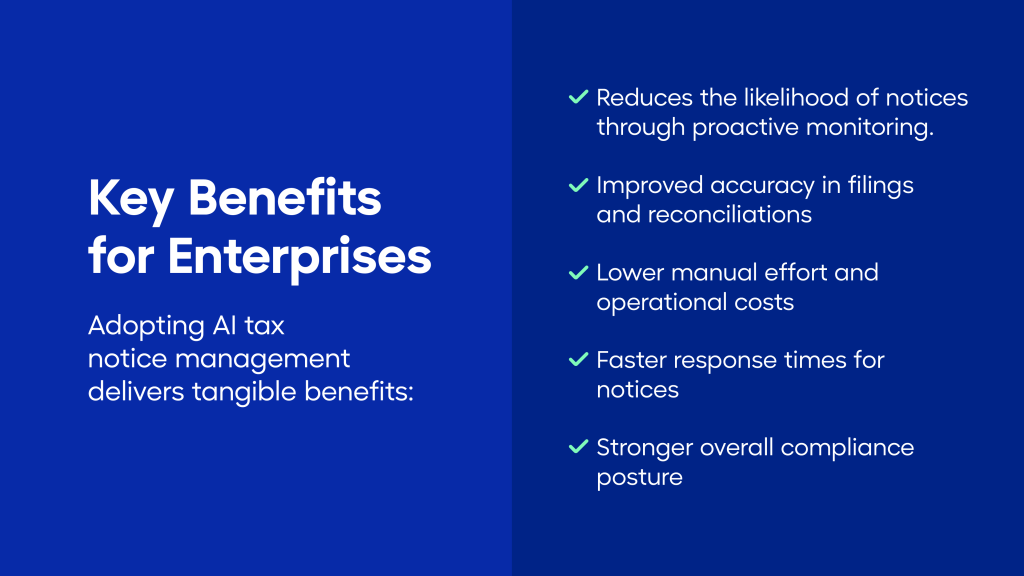
When combined with tax compliance automation and effective notice risk detection, enterprises can reduce disruptions caused by tax notices and manage them more efficiently.
Conclusion
As tax systems become more data-driven, the margin for error continues to shrink. Enterprises can no longer rely solely on manual processes or reactive strategies to manage compliance.
AI offers a practical path forward.
By enabling continuous monitoring, improving accuracy, and supporting early risk identification, AI tax notice management allows organizations to stay ahead of issues rather than respond after the fact. Solutions like Optotax further strengthen this approach by centralizing notice tracking, linking responses with reconciled data, and streamlining the entire notice lifecycle.
For enterprises looking to scale while maintaining strong compliance, this shift is becoming increasingly important.
FAQs
1. What is AI tax notice management?
AI tax notice management refers to the use of artificial intelligence to detect, prevent, and manage tax notices by analyzing transaction data, identifying risks, and assisting in response workflows.
2. How does AI help with DRC 01 prevention?
AI helps reduce the likelihood of DRC-01 notices by identifying discrepancies such as mismatches in tax filings or input tax credit claims before they are flagged by authorities.
3. What is notice risk detection in tax compliance?
Notice risk detection involves using AI to analyze financial and tax data to identify patterns or anomalies that could trigger a tax notice.
4. Can AI fully automate tax compliance?
AI supports tax compliance automation by handling repetitive tasks such as reconciliation and validation. However, human oversight remains important for decision-making and final review.
5. Is AI suitable for large enterprises only?
While large enterprises benefit the most due to scale and complexity, AI-based compliance solutions can also be adapted for mid-sized businesses with growing transaction volumes.