
For many enterprises, GST compliance is not just about filing returns on time. It’s also about maintaining the ability to go back and correct what may have been missed.
That window is now clearly defined.
With the introduction of the GST 3-year time bar, businesses no longer have indefinite time to make corrections to past returns through the GST portal. Once this period closes, certain changes can no longer be carried out within the system. For enterprises managing large volumes of transactions across multiple systems, this makes proactive review more important than ever.
What is the GST 3 Year Time Bar?
The GST 3-year time bar is the maximum period within which businesses can file specified GST returns or make amendments to previously reported details. After this period, the GST portal restricts further changes.
The GST 3-year time bar restricts how long a business has to file certain GST returns or make corrections to previously reported details.
In simple terms, specified GST returns cannot be filed, and amendments to earlier disclosures cannot be made, after three years from their original due date. This applies to key returns such as GSTR-1 and GSTR-3B, among others, where relevant.
For example:
A return with a due date in July 2021 cannot be filed, and amendments cannot be made on the GST portal after July 2024.
Even if discrepancies are identified later, the system does not permit filing or amendments beyond this period.
This has a direct impact on how enterprises approach late GST returns and corrections.
Why This Matters for Enterprises
Large organizations often deal with:
- Multiple GST registrations
- Complex vendor ecosystems
- High transaction volumes
- ERP integrations across departments
In such setups, discrepancies don’t always surface immediately. They may appear during internal reviews, audits, or reconciliations conducted much later.
With the GST 3-year time bar in place:
- Delayed corrections may no longer be possible through the GST portal
- Input tax credit mismatches may remain unresolved within the system
- Compliance gaps can attract scrutiny during assessments
This is where a structured historical return audit becomes critical.
The Risk of Ignoring Old Returns
The Risks of the 3-Year Time Bar
Permanent Loss of ITC
If purchase data was missed or incorrectly reported, the opportunity to claim Input Tax Credit is permanently lost once the portal locks.
Unresolved GSTR Mismatches
Mismatches between GSTR-1 and GSTR-3B that cannot be amended will inevitably lead to notices or demands during departmental audits.
Compounding Tax Exposure
Underreported tax liabilities that cannot be corrected systematically will compound into severe interest penalties and tax exposure.
Complete System Lock-In
Once the 3-year deadline passes, corrections require highly complex legal or departmental intervention instead of a simple portal update.
It’s easy to prioritize current filings and defer older issues. But with a defined cutoff, that approach carries real consequences.
Some common risks include:
1. Loss of input tax credit (ITC)
If purchase data was missed or incorrectly reported, the opportunity to claim ITC may no longer be available through the GST portal once the deadline passes.
2. Mismatch between GSTR-1 and GSTR-3B
Unresolved mismatches can lead to notices or demands during departmental reviews.
3. Incomplete reporting of liabilities
Underreported tax liabilities, if not corrected within the allowed time, may lead to additional tax exposure, interest, or penalties.
4. System lock-in
Once the GST filing deadline linked to the 3-year limit passes, the portal restricts further action. At that point, corrections may require legal or departmental intervention rather than system-based updates.
Why Historical Return Audit Should Be a Priority
A historical return audit is not just a compliance exercise. It’s a risk management step.
Enterprises should review:
- Filed data vs. underlying transaction records
- ITC claimed vs. eligible ITC
- Vendor reporting consistency
- Amendments to earlier disclosures that were not made
This exercise helps identify issues while there is still time to act.
More importantly, it allows businesses to:
- Clean up legacy discrepancies
- Align financial records with GST filings
- Avoid last-minute corrections close to the deadline
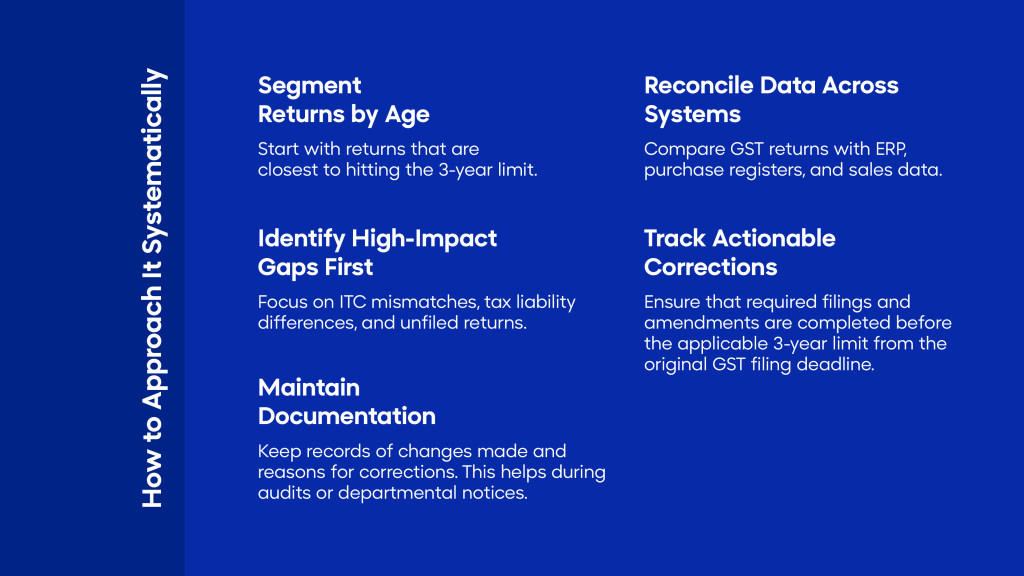
What Enterprises Should Do Before the Deadline
As returns approach the 3-year cutoff, enterprises need to act with clear priorities.
- Identify returns nearing the 3-year cutoff
- Run reconciliation immediately
- Prioritize high-value ITC cases
- Complete required filings and amendments before the system restricts further changes
Executing this manually across multiple entities and years can be complex. This is where modern GST compliance tools play a critical role. They help by:
- Flagging returns approaching the 3-year limit
- Highlighting discrepancies across filings and underlying data
- Mapping transactions to reported GST data
- Creating audit trails for filings and amendments
Platforms like Optotax enable enterprises to operationalize this at scale by providing visibility into past filings, surfacing discrepancies early, and helping teams take corrective action within the allowed timeframes.
As deadlines approach, having the right systems in place can make the difference between timely compliance and missed correction windows.
Stay ahead of GST deadlines. Explore how Optotax can help.
A Shift in Compliance Mindset
The GST 3-year time bar changes how businesses need to think about compliance.
It is no longer enough to:
- File returns on time
- Address issues whenever they are discovered
Instead, enterprises need to:
- Continuously monitor past filings
- Periodically audit historical data
- Act within defined statutory timeframes
The focus shifts from reactive correction to proactive control.
Closing Thoughts
The introduction of the GST 3-year time bar brings clarity, but also urgency.
For enterprises, the real challenge is not understanding the rule. It ensures that no critical corrections are left pending until they can no longer be corrected through the GST portal.
A disciplined approach to late GST returns, combined with regular historical return audits, can help reduce long-term compliance risks and financial exposure.
As compliance requirements evolve, having the right systems in place, such as Optotax, can help enterprises stay ahead of critical deadlines and reduce risk.
FAQs (Frequently Asked Questions)
1. What is the GST 3-year time bar?
It is the maximum time allowed to file specified GST returns or make amendments to previously reported details. After three years from the original due date, such actions cannot be carried out on the GST portal.
2. Can late GST returns be filed after 3 years?
No. Once the 3-year period from the original GST filing deadline expires, the system blocks the filing of those returns.
3. Why is a historical return audit important now?
Because it helps identify and address discrepancies in past returns before they can no longer be corrected through the GST portal.
4. What happens if errors are found after the time bar expires?
Corrections cannot be made through the GST portal. The issue may then require legal or departmental intervention and could have financial implications.
5. Which returns are affected by the 3-year limit?
The restriction broadly applies to specified GST returns such as GSTR-1 and GSTR-3B, among others, based on their respective GST filing deadlines.