

Key Takeaways
- End the month-end scramble: AI shifts vendor reconciliation from a reactive, end-of-month chore to a continuous, real-time process.
- Catch mismatches early: Instead of waiting for a vendor dispute, machine learning instantly flags duplicate invoices, misapplied payments, and missing entries.
- Fuzzy matching beats rigid rules: Unlike traditional ERPs that require exact data matches, AI connects records even when invoice formats, PO numbers, or vendor names vary slightly.
- Scale without adding headcount: By automating the tedious matching of invoices, POs, and bank statements, lean finance teams can handle high transaction volumes effortlessly.
For finance teams, vendor reconciliation has traditionally been a time-consuming process of matching invoices, purchase orders, and payment records to ensure that internal records align with supplier statements. As businesses scale and transaction volumes increase, even small discrepancies can quickly lead to vendor disputes, delayed payments, or accounting errors.
This is where vendor reconciliation AI is transforming finance operations. Instead of discovering mismatches only during month-end reviews, AI-powered systems can automatically match transactions and flag anomalies much earlier in the reconciliation cycle, enabling faster resolution and clearer financial visibility.
For modern finance leaders in India, adopting AP vendor mismatch detection powered by AI is becoming an important step toward building more scalable and resilient finance operations.
This blog explains how AI-driven reconciliation works, why it matters for growing businesses, and how finance teams can deploy it effectively.
TL;DR: AI-Powered Vendor Reconciliation
| Key insight | What it means |
| Vendor reconciliation AI | Uses automation and machine learning to match invoices, payments, and vendor statements automatically |
| Early mismatch detection | Flag discrepancies before they turn into vendor disputes |
| Faster AP workflows | Reduces manual reconciliation effort and speeds up accounts payable workflows |
| Better vendor relationships | Enables faster dispute resolution and clearer payment tracking |
| Scalable finance operations | Supports high transaction volumes without increasing manual workload |
What Is Vendor Reconciliation?
Vendor reconciliation is the process of verifying that a company’s internal financial records match the records maintained by its suppliers. In practice, this means ensuring that the accounts payable balance recorded in the company’s books aligns with what the vendor reports in their statement.
Finance teams typically compare multiple data points, including:
- Purchase orders
- Vendor invoices
- Goods received notes
- Payment transactions
- Supplier statements
The goal is simple: ensure that the amount your business believes it owes a vendor matches what the vendor records in their statement.
Also read: Mastering Vendor Reconciliation in Accounts Payable: A Practical Guide for Finance Teams
Example
A mid-sized Indian manufacturing business may process:
- 200–300 vendor invoices per month
- Payments across multiple bank accounts
- Monthly supplier statements from logistics and raw material vendors
Even one mismatch — such as a duplicate invoice or misapplied payment — can trigger reconciliation issues.
This is why supplier statement reconciliation is considered a key accounts payable control.
Why Vendor Mismatches Are a Growing Problem
As businesses grow, reconciliation complexity increases significantly.
Common causes of mismatches include:
1. Duplicate invoices
Vendors may accidentally send the same invoice multiple times.
2. Incorrect purchase order references
Invoices may reference the wrong PO number.
3. Payment allocation errors
Payments may be recorded against the wrong invoice.
4. Missing entries
Transactions may not be recorded at the same time in both systems.
5. Credit notes and partial payments
Adjustments can create discrepancies between records.
According to findings from PwC benchmarking research, finance professionals still spend around 30% of their time collecting financial data and reconciling it across systems, leaving less capacity for higher-value strategic work.
For Indian SMBs operating with lean finance teams, manual reconciliation can quickly become a bottleneck.
What Is Vendor Reconciliation AI?
Vendor reconciliation AI refers to the use of machine learning and intelligent automation to automatically match invoices, payments, and vendor statements while identifying discrepancies.
Unlike traditional rule-based automation, AI systems can:
- Recognize matching patterns in messy datasets
- Identify anomalies across large transaction volumes
- Learn from historical transaction and reconciliation data
- Improve matching accuracy over time
This enables automated vendor matching while significantly reducing manual reconciliation effort.
How AI-Powered Vendor Reconciliation Works
AI-powered reconciliation tools typically follow a structured workflow.
1. Data integration
The system pulls data from multiple sources, such as:
- ERP systems
- Accounting platforms
- Vendor invoice data
- Bank transactions
- Purchase order records
2. Intelligent invoice matching
Machine learning models compare financial records using multiple attributes, including:
- Invoice numbers
- Vendor names
- Payment amounts
- Transaction dates
- Purchase order references
Unlike traditional systems that require exact matches, AI can identify close matches even when data formats differ.
This significantly improves automated vendor matching in India, especially in environments where vendor data formats vary across systems.
3. AI-based anomaly detection
The system then scans transactions to identify potential discrepancies.
Examples include:
| Scenario | AI detection method |
|---|---|
| Duplicate invoice | Same vendor, amount, and invoice pattern |
| Underpayment | Payment amount lower than invoice value |
| Overpayment | Payment exceeds invoice amount |
| Missing invoice | Payment exists without an invoice record |
This enables AP vendor mismatch detection before disputes arise.
4. Exception workflows
Instead of manually reviewing every transaction, finance teams only review flagged discrepancies.
This improves efficiency and helps prevent:
- Duplicate payments
- Vendor disputes
- Incorrect accounting entries
Benefits of AI-Powered Vendor Reconciliation
1. Faster reconciliation cycles
Automation enables reconciliation to happen continuously rather than only at month-end. This helps finance teams maintain better financial visibility throughout the accounting cycle.
2. Early error detection
AI can detect discrepancies much earlier in the reconciliation process, allowing teams to resolve issues before they escalate. This significantly improves AP dispute prevention.
3. Lower operational costs
Manual reconciliation requires significant time and administrative effort.
Automation helps reduce:
- Manual data matching
- Spreadsheet dependency
- Reconciliation errors
4. Stronger vendor relationships
Timely reconciliation improves transparency between businesses and suppliers.
This leads to:
- Faster dispute resolution
- Accurate payment tracking
- Better supplier trust
How CFOs in India Are Using AI for Finance Operations
Across global finance teams, AI adoption is accelerating.
Many finance teams are now integrating AI into operational workflows such as reconciliation, fraud detection, and financial forecasting.
This reflects a broader shift toward CFO AI finance operations in India, where automation supports more scalable and data-driven financial management.
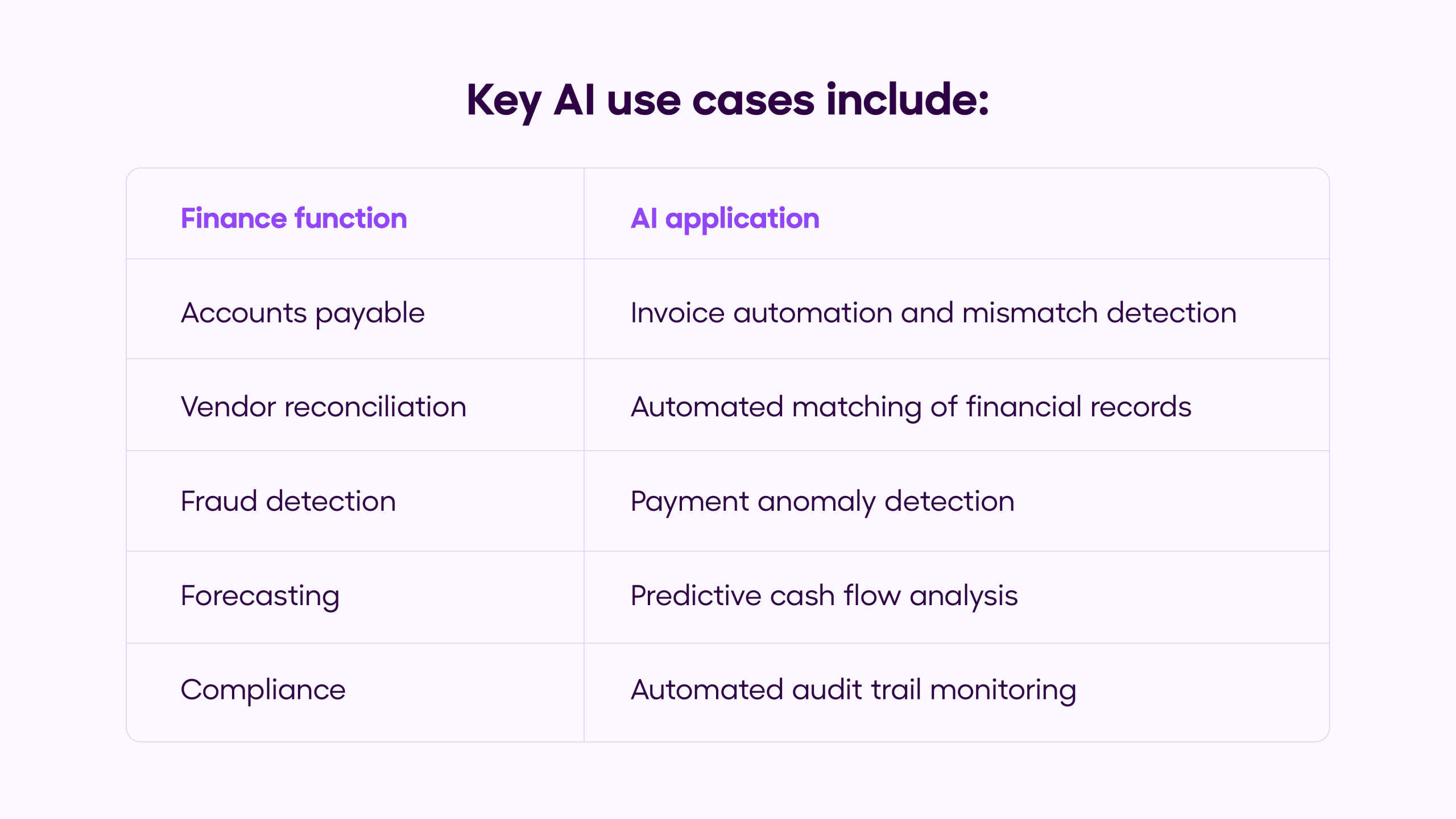
For finance leaders developing a CFO AI strategy in India, reconciliation automation is often a practical starting point.
Deploying AI in Finance Teams: Practical Steps
Organizations deploying AI finance team workflows should follow a structured approach.
1. Identify high-volume processes
Reconciliation is ideal for automation because it involves repetitive data matching and large volumes of financial records.
2. Integrate financial systems
AI tools should connect with key financial systems, including:
- ERP systems
- Accounting platforms
- Banking APIs
- Vendor invoice systems
3. Implement AI change management
Successful adoption requires clear communication and training.
Finance teams should:
- Train staff on AI tools
- Update reconciliation workflows
- Establish exception handling processes
This is a critical part of AI change management finance initiatives.
4. Monitor system performance
AI systems improve as they process more data.
Regular monitoring helps improve key performance indicators such as :
- Matching accuracy
- Anomaly detection
- Workflow efficiency
The Future of Vendor Reconciliation
Vendor reconciliation is evolving toward more automated and near-real-time finance operations.
Emerging trends include:
- AI-driven dispute prediction
- Real-time supplier statement reconciliation
- Integrated bank and ERP reconciliation
- Automated payment anomaly alerts
India’s digital payments infrastructure continues to expand, with platforms such as UPI accelerating financial automation across businesses.
For finance teams handling growing transaction volumes, adopting AI-driven reconciliation is becoming an essential capability.
How OPEN Helps Simplify Vendor Reconciliation
As finance workflows grow more complex, businesses need systems where banking, payments, and financial operations stay connected.
OPEN provides a unified platform that helps businesses manage financial operations by connecting banking infrastructure with modern financial workflows.
With connected financial data, businesses can:
- Track vendor payments more clearly
- Simplify reconciliation processes
- Identify discrepancies earlier in the accounts payable cycle
This creates a stronger foundation for automated finance operations and scalable vendor reconciliation.
👉 Explore how automation can simplify finance workflows.
FAQs (Frequently Asked Questions)
1. What is vendor reconciliation AI?
Vendor reconciliation AI uses machine learning to automatically match invoices, payments, and supplier statements while identifying discrepancies in financial records.
2. Can AI be used for reconciliation?
Yes. AI-powered reconciliation systems can quickly match large volumes of financial transactions and identify discrepancies, helping finance teams handle growing transaction volumes without increasing manual workload.
3. Is automated vendor matching useful for Indian SMBs?
Yes. Automated vendor matching helps businesses manage large volumes of invoices and payment transactions while reducing manual reconciliation work.
4. How can CFOs deploy AI in finance teams?
CFOs typically begin by automating high-volume processes such as invoice processing, vendor reconciliation, and payment tracking before expanding AI to forecasting and analytics.
5. Does AI replace finance teams?
No. AI supports finance teams by automating repetitive tasks, allowing finance professionals to focus on analysis, vendor relationships, and strategic planning.