
Key Takeaways
- Purchase-to-pay automation covers the full cycle from purchase request to vendor payment — broader and more strategic than standalone AP tools.
- Most P2P platforms break at scale because control gaps appear at payment execution, not invoice capture.
- In India, effective P2P software must handle GST/ITC matching, MSME timelines, and direct bank execution — not just digitize paperwork.
- The best platform is the one where payment correctness and financial closure are built into the workflow, not bolted on afterward.
Choosing the best procure-to-pay (P2P) software in India for 2026 requires a shift in perspective. What was once treated as a back-office function now directly impacts working capital predictability, vendor trust, and compliance.
As transaction volumes grow, the gap between raising a purchase request and settling an invoice becomes a source of errors, missed GST input tax credits (ITC), and vendor disputes. Modern finance teams are moving beyond digitizing paperwork—they are building a touchless financial supply chain.
In India, this means reliable 3-way matching, MSME compliance tracking, and accurate, timely vendor payouts at scale.
This guide evaluates leading procure-to-pay platforms in India and helps you identify which solutions, often also referred to as purchase-to-pay software, actually scale with enterprise complexity.
What is Procure-to-Pay (P2P) Automation?
Procure-to-pay (P2P) automation, often referred to as purchase-to-pay automation, is the end-to-end digitization of procurement and accounts payable from purchase request to vendor payment. It replaces manual approvals, data entry, and reconciliation with controlled workflows that validate transactions, reduce errors, and provide real-time financial visibility.
The P2P Automation Lifecycle:
A scalable purchase-to-pay system manages five core stages:
Purchase Requisition (PR): Employees submit digital purchase requests routed automatically for approval.
Purchase Order (PO): Approved requests generate a purchase order and send it to the vendor.
Goods Received Note (GRN): Teams record delivery, linking received goods to the original order.
Invoice Processing: OCR captures invoice data and performs 3-way matching (PO vs GRN vs Invoice).
Final Payment: Validated invoices are paid automatically and synced to the ERP for book closure.
Why Most Procure-to-Pay Software Breaks When Companies Grow
Every P2P tool looks reliable at 500 invoices a month. Then the business scales.
Finance teams suddenly face vendors changing bank accounts, GST mismatches blocking filings, approvals happening on chat, payout files failing in bank portals, reconciliation taking days, and audit queries months later that nobody can trace.
At this point, companies don’t have a software problem — they have a control problem.
Most procure-to-pay platforms digitize invoices. Very few actually control payments, and that gap only becomes visible at scale.
Many implementations, therefore, fail after 12–18 months. Scaling AP rarely fails at invoice capture; it fails at payment correctness. When payment decisions happen outside the system, risk and manual effort return.
For a P2P automation platform to scale reliably, it must manage five checkpoints inside the system:
- Vendor authenticity before payment
- Enforceable approvals (not advisory workflows)
- Direct payment execution
- Pre-payment compliance validation
- Automatic financial closure
If any of these exist outside the workflow, finance teams end up rebuilding manual processes around the software.
The next section compares leading solutions in India to identify which platforms actually support this level of control at scale.
How to Evaluate Procure to Pay Platforms in India
Selecting a platform in the Indian context requires a specific lens. Before investing in an enterprise AP automation tool, ask these four questions:
- GST & ITC Matching: Does the software check if the vendor has uploaded the invoice to the GST portal before you release payment?
- MSME Compliance: Can the system flag invoices from MSME-registered vendors to ensure they are paid within the MSME payment timelines (15–45 days)?
- ERP Integration: Will it sync bidirectionally with Tally, SAP, or Oracle in real-time?
- Direct Payouts: Can you execute payments directly from the dashboard, or do you have to upload a CSV to a legacy bank portal?
These questions help you quickly identify whether a platform understands Indian compliance and banking realities. However, answering “yes” during a demo isn’t enough — the real test is whether these controls operate inside the workflow, not as external integrations or manual steps.
The following checklist breaks this down into operational capabilities you should verify before making a final decision.
How to Evaluate Purchase-to-Pay Software (Checklist)
| Pay vendors directly from the system without bank files | What Good P2P Software Must Do | If Missing |
| Vendor Verification | Validate PAN/GST, verify bank beneficiary name, track MSME status | Wrong vendor payments, fraud, compliance risk |
| Approval Control | Role-based approvals with mandatory enforcement & audit trail | Payments bypass process |
| Invoice Accuracy | 3-way match (PO-GRN-Invoice) and duplicate detection | Overpayments & disputes |
| Payment Execution | Pay vendors directly from system without bank files | Manual work & failures |
| Compliance | GST & TDS checks before payout | ITC loss & penalties |
| Reconciliation & Closure | Auto reconciliation, ERP posting, payment advice to vendors | Month-end chaos & follow-ups |
A true P2P system doesn’t just process invoices — it ensures payment correctness and financial closure. Check out the short comparison below evaluating leading platforms in India against these operational controls.
Top Purchase-to-Pay Software in India (2026)
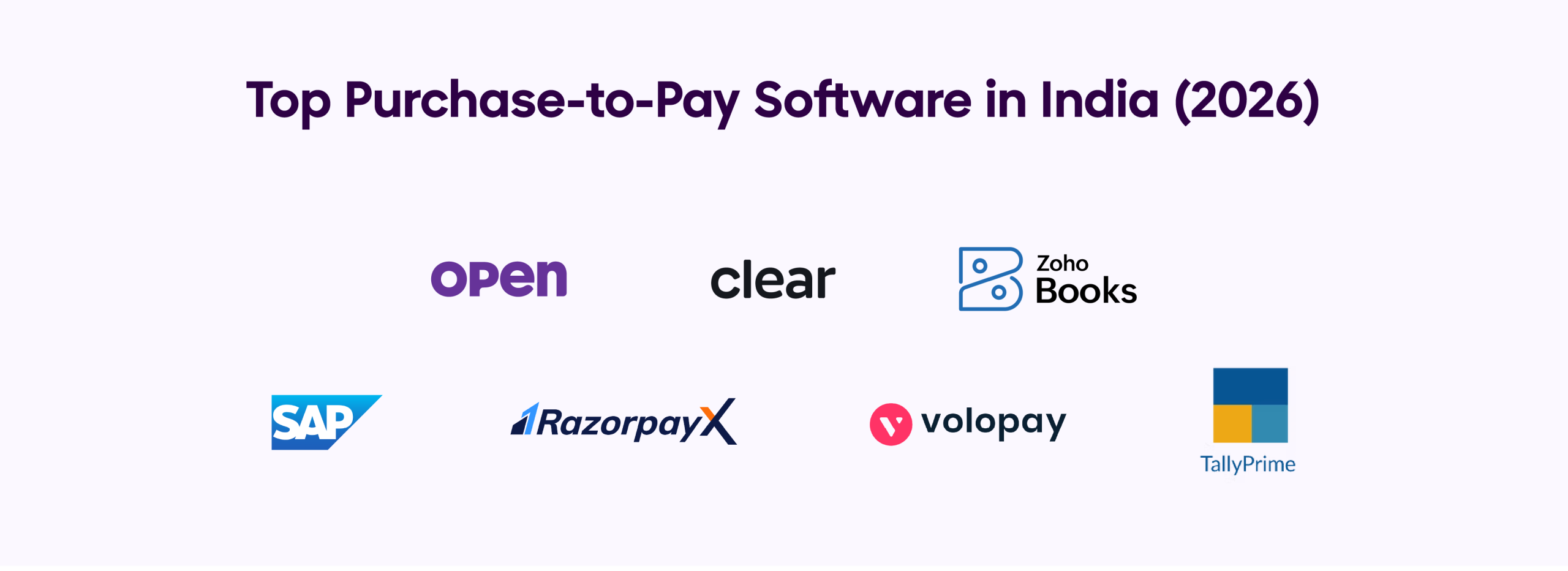
Indian businesses across different scales and operational needs widely use the following procure-to-pay software platforms. Each approaches P2P differently — some focus on compliance, some on procurement workflows, and others on payment execution.
1. OPEN (Open Money)
OPEN treats procure-to-pay software as a financial control system rather than just an invoice processing workflow. The platform begins AP control at vendor onboarding by validating tax identity and verifying the bank beneficiary name before payment can be released through the workflow. This helps prevent the most common failure at scale — paying the wrong account even when the invoice itself is correct.
From there, approvals, compliance checks, payment execution, and reconciliation operate inside a single controlled environment. Instead of finance teams managing a chain of Excel files, bank templates, failed uploads, statement downloads, and manual reconciliation, the entire payout lifecycle runs within one system that records who approved what and when before the payment is executed.
Key Features
Verified Vendor Onboarding: Validate PAN, GST, MSME status, and bank beneficiary name to create a locked vendor record and block payments on beneficiary mismatch within the workflow
Invoice Inbox & Bill Creation: Collect invoices in a centralized inbox, convert to bills, and track aging to avoid missed liabilities and MSME timeline risks.
Enforceable Approval Controls: Payments cannot be executed outside the authorization workflow, with a full audit trail capturing approver identity and timing.
3-Way Matching: Automatically reconcile purchase order, goods receipt note, and invoice to prevent quantity and pricing discrepancies.
Direct Bank Execution: Initiate NEFT, RTGS, and IMPS payments without bank file uploads, eliminating template failures and manual debugging.
Pre-Payment Compliance Checks: Surface GST risks before payout instead of discovering them during filing
Automatic Closure & Vendor Advice: Map UTR to invoices and send payment advice to vendors to reduce follow-ups and reconciliation disputes.
ERP Synchronization: Post entries to Tally, Zoho Books, and SAP automatically, enabling faster book closure and audit readiness.
2. Clear AP
Clear AP focuses on compliance accuracy and document digitization within the procure-to-pay lifecycle. The system uses structured extraction to capture complex Indian invoice formats and identify tax mismatches early. It is particularly useful for companies where GST correctness and ITC recovery are the primary AP challenges. Finance teams typically adopt it to reduce manual data entry and vendor correction cycles.
Key Features
- AI-powered OCR for touchless invoice data extraction.
- Built-in GST and TDS discrepancy detection checks.
- Workflows designed to improve input tax credit accuracy
- Vendor collaboration portal for invoice correction and communication.
- Compliance-focused reporting for audit readiness.
3. SAP Ariba
SAP Ariba is a global procure-to-pay platform built around structured sourcing and supplier network governance. It provides standardized purchasing processes across large, multi-country organizations with formal procurement teams. The platform emphasizes policy enforcement, contract lifecycle management, and supplier discovery. It is typically deployed in enterprises with centralized procurement operations and long implementation horizons.
Key Features
- Access to a large global supplier network for vendor discovery.
- Guided buying workflows aligned with corporate purchasing policies.
- Contract lifecycle and agreement repository management.
- Advanced spend analytics using machine learning models.
- End-to-end sourcing and procurement governance controls.
4. TallyPrime (with Bharat Connect)
TallyPrime is now extended with connected workflow capabilities to support purchase-to-pay operations. Businesses can move from manual bookkeeping to structured PO-based accounting within the familiar interface. It works well for organizations wanting operational discipline without migrating away from Tally. The system bridges traditional accounting practices with basic workflow automation.
Key Features
- Full P2P cycle, including purchase order, receipt note, and bill tracking.
- Automated bank reconciliation across major Indian banks.
- Bharat Connect invoice exchange through connected business integrations
- Built-in e-Invoice and e-Way bill generation from ledger entries.
- Inventory-linked purchase tracking within accounting books.
5. RazorpayX
RazorpayX offers a fintech-style payable and payout management experience designed for digital-first companies. The platform combines vendor onboarding, tax payments, and payouts in a simplified operational interface. It is widely used by startups and D2C brands managing frequent vendor and partner payouts. The focus is on usability and payout efficiency rather than deep procurement matching.
Key Features
- Vendor onboarding and KYC collection workflows.
- Automated TDS calculation and tax payments.
- Bulk payouts and approval routing.
- Real-time spend analytics by department or cost center.
- API integrations for product-led businesses.
6. Volopay
Volopay approaches P2P from a spend management perspective centered around corporate cards. Instead of invoice-driven payments, it controls decentralized company spending through programmable limits. The platform works well for organizations with subscriptions, travel expenses, or distributed teams. It reduces reimbursement overhead while maintaining visibility into spending.
Key Features
- Unlimited virtual and physical corporate cards with spend limits.
- Automated employee reimbursement workflows.
- Multi-currency vendor payments.
- Expense capture through mobile and web apps.
- Accounting integrations for real-time expense syncing.
7. Zoho Books (P2P Module)
Zoho Books provides an integrated accounting ecosystem with procurement workflows built into the platform. Businesses already using Zoho applications can connect purchasing, inventory, and payables in a single system. It offers a gradual path from basic bookkeeping to structured purchase approvals. The tool suits SMEs wanting unified operations across finance and operations teams.
Key Features
- Multi-level approval workflows for vendor bills.
- Integration with Zoho Inventory for stock-based purchasing.
- Connected banking payments via banking integrations
- Vendor statements and outstanding balance tracking.
- Automated bookkeeping across the Zoho ecosystem.
Final Thoughts
The best purchase-to-pay software isn’t the one with the most features — it’s the one that fits how your finance team actually operates. In India, that means handling GST compliance, banking execution, and audit controls in a way that works reliably at scale.
OPEN AP is designed for businesses that want payment control alongside automation as they grow in 2026.
Want to see how it fits your workflow? Book a personalized demo and explore how your P2P process can move from tracking invoices to predictable closure.
FAQs
1. What is the difference between AP automation and P2P software?
AP automation focuses specifically on the invoice and payment. Purchase to pay software is broader, covering the entire cycle from the initial purchase request to the final accounting entry.
2. Can I use P2P software without changing my existing ERP?
Yes. Modern scalable P2P systems like OPEN are designed to sit on top of your existing ERP (Tally, SAP, etc.) and sync data bidirectionally.
3. How does P2P software help with GST compliance?
Advanced P2P automation software checks the vendor’s GST filing status before you release the payment, ensuring you never lose out on Input Tax Credit (ITC).
4. What is “3-way matching” and why is it important?
It ensures that you only pay for what you ordered and actually received. By matching the PO, GRN, and Invoice, you eliminate the risk of fraud and billing errors.