

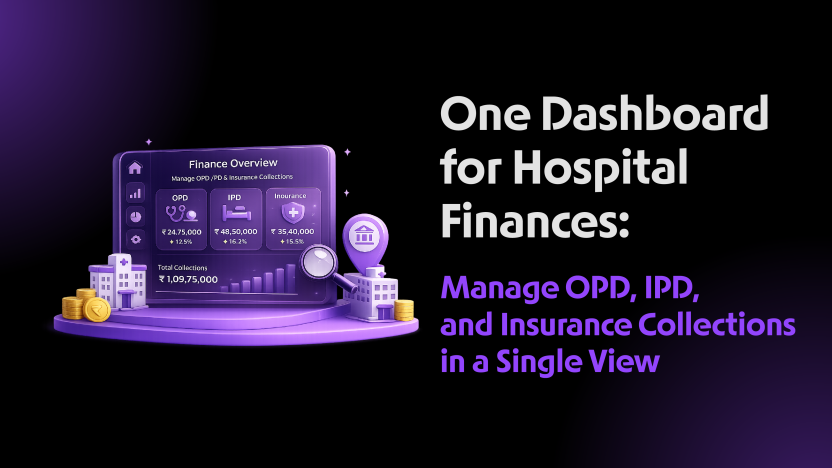
Your finance head asks a simple question on Monday morning: how much did the hospital actually collect last week?
The billing team has one number. The OPD counter has another. The insurance team is still chasing responses from Thursday. Three discharged patients haven’t cleared their final bills yet.
No one made a mistake. No one is cutting corners. The problem is visibility.
Your hospital finance dashboard—or the absence of one—is forcing your team to piece together a complete picture from systems that were never built to work together. Connected banking for hospitals helps bring OPD, IPD, insurance payments, and collections into one place, so finance teams stop switching between systems and start acting faster.
According to CRISIL Research, billing and collections remain one of the biggest operational challenges for Indian hospitals, especially across OPD, IPD, and insurance workflows.
This guide breaks down what a unified hospital finance dashboard actually does, why it matters for OPD, IPD, insurance payments, and hospital collections management, and how to evaluate the right one.
What Is a Hospital Finance Dashboard?
A hospital finance dashboard is a live, role-based interface that consolidates billing and collection data from every revenue stream—outpatient services, inpatient stays, pharmacy, diagnostics, and insurance claims—into a single view.
It is not a report you pull at month-end. It is a real-time picture of what has been billed, what has been collected, and what is still pending right now.
The keyword is “live.” A dashboard that refreshes overnight is, functionally, a report. A genuine hospital finance dashboard updates continuously as transactions happen, claims move through approvals, and patients are admitted or discharged.
Many hospitals today use multiple systems to track collections—an HMS for inpatient billing, a separate counter system for OPD, and spreadsheets or a TPA portal for insurance. A unified dashboard sits above all of these, pulling data from each source so your team stops cross-referencing and starts acting.
Why Hospital Collections Management Breaks Without a Unified View
Where Hospital Finance Actually Breaks Down
Outpatient (OPD)
High transaction volumes across cash, card, and UPI mean small mismatches add up quickly. Without live syncing, most missing funds are caught weeks after they happen, not the same day.
Inpatient (IPD)
A five-day admission generates charges across the ward, OT, lab, and pharmacy. Without a running total visible to staff, the discharge bill feels like a surprise—and collections get delayed.
Insurance & TPAs
Pre-authorizations, cashless settlements, and partial rejections. Without centralized visibility, your team cannot tell which claims need urgent escalation and which are resolved.
The damage from fragmented hospital finance tracking is not dramatic. It is slow.
It shows up in reconciliation hours at month-end, in insurance claims that quietly age past the follow-up window, and in discharge conversations that turn tense because a family is seeing their bill for the first time.
Here is where the gaps actually cost money:
OPD: High transaction volumes across cash, card, and UPI mean small mismatches add up. Most are caught weeks after they happen, not the same day.
IPD: A five-day admission can generate charges across the ward, OT, lab, and pharmacy. Without a running total visible to both staff and patients, the discharge bill feels like a surprise—and collections get delayed.
Insurance: Pre-authorisations, cashless settlements, reimbursements, partial approvals, and rejections. Each claim is its own process. Without healthcare finance visibility across OPD, IPD, and insurance payments, your team cannot tell which claims need urgent escalation and which have already been resolved.
The real cost is not any single missed payment. It is the cumulative effect of a finance team spending half its time hunting for information instead of acting on it.
How a Hospital Finance Dashboard Works
A well-built hospital finance dashboard connects to your existing Hospital Management System (HMS) and other billing tools via API or a data integration layer.
It does not replace those systems. It reads from them continuously and surfaces the right information to the right person.
Here is what the data flow looks like in practice:
- The HMS, OPD billing system, and TPA or insurance portal each generate transaction records independently
- The dashboard pulls these records in real time and maps them to a common data model, linking each charge, payment, and claim to the correct patient and department
- Role-based views are applied so each team member sees only what is relevant to their function
- Alerts and flags surface automatically when a claim ages past a threshold, a bill approaches a patient’s deposit limit, or a payment appears unmatched.
What Changes When Everything Sits in One Place
The operational shift is bigger than cleaner numbers. Here’s what your team actually gains:
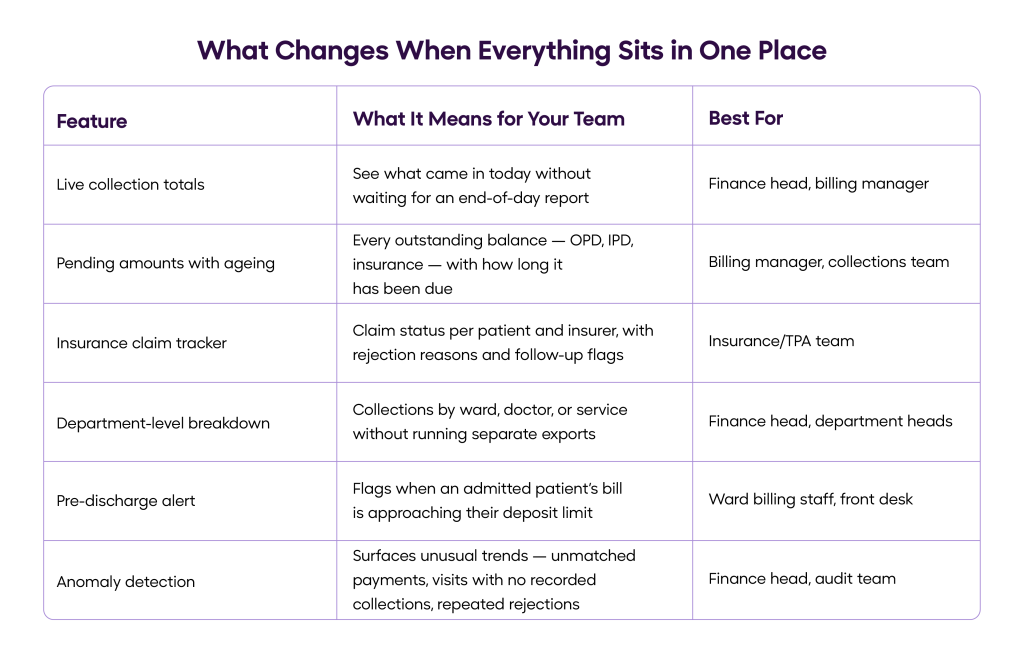
Hospitals that have made this shift report an 18% average reduction in insurance claim settlement time and roughly 30% less time spent on month-end reconciliation by billing teams. Those aren’t technology wins. They’re what happens when people stop chasing information.
How OPEN Connected Banking for Hospitals Gives You Control Over Collections, Bank Accounts, and Payouts
Finance teams using OPEN Connected Banking for hospitals bring multiple bank accounts, hospital collections management workflows, and payout tracking into one place.
That means better healthcare finance visibility across OPD, IPD, insurance payments, vendor payouts, pharmacy collections, and contractor disbursements.
- Unified balance view across all accounts, with clear identifiers for operations, payroll, vendor payouts, and more
- Works with leading banks, including ICICI, HDFC, SBI, Axis, Kotak, Yes Bank, IDFC, HSBC, and Standard Chartered
- Statements and transactions in one place, with filters and downloads from the date of connection
- Single fund transfer flow: select debit account, beneficiary, amount, and payment mode, then authorise via OTP
- Centralised tracking of all payouts, with complete transaction details in one view
- Beneficiary management with IFSC validation and auto-fetching bank details for faster, error-free transfers
From vendor payments to pharmacy payouts and contractor disbursements, your team can execute and track payments without relying on multiple bank portals.
Schedule a demo with OPEN Connected Banking
Frequently Asked Questions
1. What is a hospital finance dashboard, and how is it different from an HMS?
A Hospital Management System (HMS) manages clinical workflows, patient records, and billing transactions. A hospital finance dashboard sits on top of your HMS and other systems to give your finance team a real-time, consolidated view of collections, outstanding amounts, and insurance claim status. They serve different functions and work best together — the dashboard doesn’t replace the HMS.
2. Our hospital already uses an HMS. Do we need to replace it to get a unified view?
No. A good financial dashboard integrates with your existing HMS via API or data connection — it doesn’t replace it. AP — Open Financial Technologies is built to work alongside the systems you already have, bringing their data together without disrupting your current setup or requiring a full migration.
3. How long does setup take?
For most hospitals, initial setup takes one to two weeks. This includes connecting to your billing and HMS systems, configuring department and role-based views, and a team walkthrough. There’s no extended IT project involved. Billing and finance staff can typically start using the dashboard within the first few days.
4. Our insurance and TPA data is managed separately. Can it still be included?
Yes — and it’s one of the main reasons hospitals move to a unified view. AP maps every active claim — pre-authorisation status, approved amounts, pending settlements, rejection reasons — to the corresponding patient record and bill. Your insurance team gets a dedicated view so they can prioritise follow-ups without switching between platforms or cross-referencing spreadsheets.
5. Is a unified finance dashboard suitable for smaller hospitals, or only large ones?
It works across hospital sizes. Smaller hospitals often see faster results because their teams are leaner — every hour spent chasing numbers has a bigger operational impact. Whether you’re running 30 beds or 300, the core problem is the same: OPD, IPD, and insurance data living in separate places. The solution scales to fit.
Ready to see your hospital’s finances in one place? AP gives your team a single, live view of every rupee collected, pending, or waiting on an insurance decision — across OPD, IPD, and insurance. No guesswork. No chasing reports.