
E-commerce businesses run on speed — fast sales cycles, fast fulfilment, and fast payouts. But behind the scenes sits a major operational challenge: managing thousands of invoices from suppliers, marketplaces, logistics partners, and dropshipping networks.
Unlike traditional retail, invoices don’t arrive in predictable batches. They flow continuously. As volumes grow, manual accounts payable workflows become slow, error-prone, and difficult to scale.
This is where the benefits of accounts payable automation become clear. Modern accounts payable is no longer just about recording expenses — it determines cost accuracy, vendor reliability, and margin protection. By digitising invoice capture, approval routing, and matching, e-commerce teams can process high volumes efficiently, reduce discrepancies, and maintain cash flow visibility even during peak sales periods.
Why E-commerce Needs a Different AP Workflow
Traditional AP systems were built for businesses with stable vendor relationships and predictable invoicing patterns. E-commerce, however, faces unique operational pressures:
✦ 1. High-Volume Invoice Processing
A single day of sales can generate hundreds of small vendor, courier, and marketplace invoices. Manual entry slows down reconciliation and increases the likelihood of payment delays.
✦ 2. Frequent Rate Changes and Adjustments
Logistics rates, marketplace commissions, GST components, and promotional reimbursements change often — making manual validation tedious.
✦ 3. Multi-Vendor, Multi-Channel Complexity
E-commerce brands handle vendors across sourcing, packaging, warehousing, fulfilment, returns, and last-mile delivery. Each creates its own invoice ecosystem.
✦ 4. Dropshipping Invoice Automation Needs
Dropshipping introduces split invoicing, POD-based billing, and multi-party settlements. Reconciling this without automation is nearly impossible.
✦ 5. Flash Sales = Flash Invoicing
During spikes like festive seasons or influencer campaigns, invoice volumes multiply overnight — creating bottlenecks across finance teams.
How AP Automation Solves E-commerce Invoice Challenges
1. OCR-Driven Invoice Capture at Scale
Automation tools extract line items, GST fields, vendor information, SKUs, order IDs, and rates with high accuracy.
✔ Eliminates manual data entry
✔ Reduces human error in SKU-level details
✔ Standardises formats from different vendors
This dramatically speeds up high-volume invoice processing, especially for logistics and warehouse invoices.
2. Automated Invoice Matching (3-Way & 4-Way)
E-commerce workflows demand tight matching between:
- PO or Purchase Order → GRN or Goods Received Note → Invoice
- Order → Shipment → Courier Bill → Returns Data
- Marketplace settlement reports → Actual payouts
Automation detects discrepancies instantly — a key accounts payable automation benefit that prevents overpayments before they happen.
Automation ensures discrepancies are detected instantly.
✔ Duplicate invoice detection
✔ Rate mismatch alerts
✔ Auto-flagging courier overcharges
✔ Automated reconciliation with order-level data
This is a core requirement for automated invoice matching in fast-moving ecommerce operations.
3. Smart Approval Workflows for Distributed Teams
Approvals in e-commerce often involve category buyers, warehouse managers, finance teams, and founders.
Automation enables:
✔ Rule-based routing
✔ Mobile approvals
✔ SLA-based reminders
✔ Vendor-wise workflows
No more chasing signatures during high-volume periods.
4. Dropshipping Invoice Automation
Dropshipping comes with complexities such as:
- Vendor invoices tied to multiple customer orders
- Split shipments and split billings
- Reverse logistics charges
- Platform-based automated order fulfilment
AP automation maps invoices directly to orders and fulfillment data, enabling:
✔ Accurate cost allocation
✔ Auto reconciliation
✔ End-to-end dropshipping invoice automation
5. Real-Time Cash Flow Visibility
With automated e-commerce AP workflows, finance teams can instantly view:
- Pending invoices
- Payables due this week
- Vendor-wise ageing
- SKU-wise cost changes
- Actual vs. expected logistics spends
Real-time visibility is a key accounts payable benefit for finance teams — it improves working capital decisions and prevents unexpected cash-outflow spikes.
Key Accounts Payable Benefits for E-commerce Growth
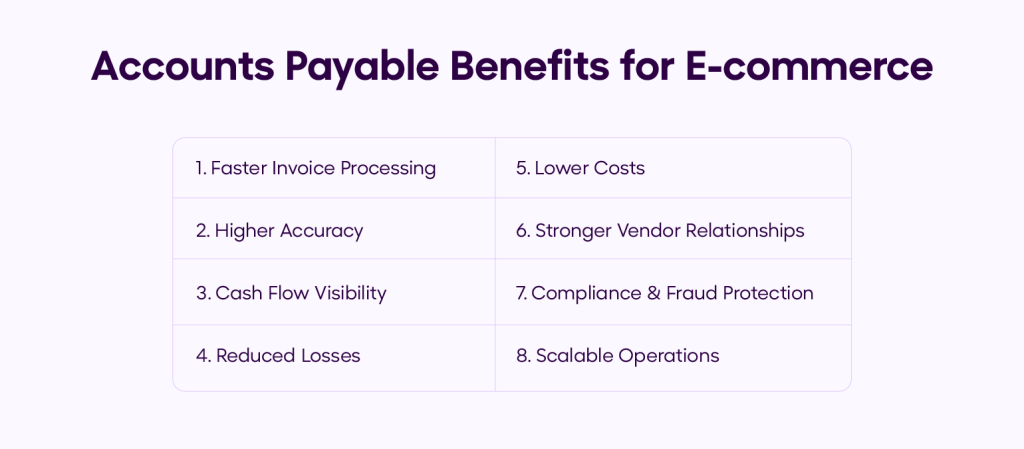
✦ 1. 60–80% Faster Invoice Processing
Digitised capture and automated PO matching move invoices from inbox to approval in minutes instead of days. Finance teams spend less time chasing documents and more time reviewing exceptions.
✦ 2. Higher Accuracy & Zero Duplicate Payments
Automated validation checks vendor details, rates, and quantities — preventing overpayments, duplicate payouts, and manual entry errors before money leaves the bank.
✦ 3. Better Cash Flow Control & Visibility
Real-time liability tracking shows exactly what is payable, when, and to whom — helping teams plan payouts, avoid sudden cash-outflow spikes, and capture early-payment discounts.
✦ 4. Reduced Returns & Courier Cost Leakages
Courier bills and return adjustments are automatically reconciled against orders and contracts, eliminating unnoticed revenue loss and margin erosion.
✦ 5. Lower Processing Cost per Invoice
Removing paper handling, data entry, and follow-ups significantly cuts operational effort — finance teams process more invoices without increasing headcount.
✦ 6. Stronger Vendor Relationships
Consistent, transparent approvals and on-time payments build supplier trust and reduce disputes, escalations, and service disruptions.
✦ 7. Built-in Compliance & Fraud Prevention
Audit trails, approval controls, and verified vendor records reduce unauthorized payouts and simplify audits and regulatory checks.
✦ 8. Effortless Scaling During Growth Seasons
Festive sales, new warehouses, and marketplace expansion increase invoice volume — not finance workload. The AP workflow scales automatically without operational bottlenecks.
What an Ideal E-commerce AP Automation System Should Include
A future-ready accounts payable system for e-commerce must offer:
✔ OCR-based invoice capture
✔ Marketplace settlement reconciliation
✔ Courier invoice matching
✔ Dropshipping invoice automation
✔ 3-way and 4-way matching
✔ Rule-based approval workflows
✔ Connected banking for instant payouts
✔ Audit trails for compliance
✔ Multi-GSTIN support
This transforms AP from a manual burden into a predictable, scalable system.
Conclusion
E-commerce companies cannot afford slow, manual AP processes — especially when dealing with thousands of invoices, fast-moving orders, and fluctuating operational costs.
AP automation for e-commerce ensures accuracy at scale, speeds up invoice workflows, and protects margins by eliminating leakages across logistics, returns, and marketplace billing.
With automated invoice matching, dropshipping invoice automation, and high-volume processing capabilities, e-commerce finance teams gain the visibility and control they need to operate at peak efficiency — every single day.
Frequently Asked Questions (FAQs)
What is an e-commerce AP workflow?
An e-commerce AP workflow refers to the end-to-end process of receiving invoices from vendors, verifying data, matching them with orders or POs, routing approvals, and processing payments. Because e-commerce businesses handle high invoice volumes, these workflows rely heavily on automation to stay efficient.
How does AP automation help with high-volume invoice processing?
AP automation uses OCR, rule-based matching, and digital workflow routing to process thousands of invoices quickly. It eliminates manual data entry, reduces errors, and allows finance teams to handle sudden invoice spikes during festive or promotional seasons.
What is automated invoice matching in e-commerce?
Automated invoice matching compares invoices with purchase orders, GRNs, shipment records, or marketplace settlement data. This ensures accuracy, flags mismatches instantly, and prevents overpayments — one of the core accounts payable benefits for high-transaction businesses.
How does dropshipping invoice automation work?
Dropshipping invoice automation maps vendor invoices directly to corresponding customer orders, fulfilment events, and return data. It handles split shipments, multi-party charges, and POD-based billing while reducing the reconciliation overhead for finance teams.
Can AP automation improve cash flow visibility for e-commerce businesses?
Yes. Automated systems provide real-time dashboards showing pending invoices, dues by vendor, weekly payables, expected payouts, and SKU-wise costs. Better visibility into liabilities is one of the most important benefits of accounts payable for managing working capital.
What types of invoices can be automated for e-commerce brands?
AP automation can process:
- Supplier invoices
- Warehouse and 3PL (Third-party logistics) bills
- Courier and logistics invoices
- Marketplace charges and settlement reports
- Dropshipping vendor invoices
- Packaging and procurement invoices
Is AP automation suitable for small e-commerce sellers?
Yes. Small and mid-sized sellers benefit the most because automation removes manual effort, reduces errors, prevents duplicate payments, and frees time during peak sales cycles.
What is 3-way accounts payable?
3-way accounts payable, or 3-way matching, is an internal control process where an invoice is verified against three documents: the Purchase Order (PO), the Goods Receipt Note (GRN) or delivery receipt, and the Supplier Invoice. This ensures that quantities, prices, and items match before payment is made, preventing errors, overpayments, and potential fraud. Implementing 3-way matching is one of the key accounts payable benefits, giving finance teams confidence in accurate, compliant payouts.