Consider a group with supplier payments running through ICICI Bank, operating balances at HDFC Bank, collections at SBI and project accounts at Axis Bank. Finance may use Oracle Fusion Cloud ERP as its common system of record, while the actual banking arrangements differ by institution, account and entity. That makes Oracle Fusion bank connectivity a design decision, not a checkbox.
Oracle can tell the team what was approved for payment. But to establish what happened next, the business needs information from its banks: whether instructions were accepted, which payments were processed and what appears in the bank statement. If those answers arrive through different portals, file uploads or disconnected interfaces, the ERP doesn’t have a complete operational view.
This isn’t a missing feature in Oracle. It is a connectivity and operating-model decision: how should bank information and payment instructions move between Oracle and the banks the business uses?
The essentials
- Oracle Fusion already handles payment processing, bank statement imports and reconciliation. The gap is how bank data and instructions cross between the ERP and each bank.
- Oracle’s embedded banking is bank- and region-specific, for example Bank of America in the US and Canada, so Indian groups usually need another route.
- Compare options bank by bank and workflow by workflow: statements, payments, status responses and exception handling.
What Oracle Fusion Cloud Financials already handles
The starting point is to recognise the functionality the enterprise already has.
Oracle Payables and Oracle Payments support supplier disbursements. Payment process requests select invoices and can stop for review and approval. Payment process profiles specify how payment files are formatted, grouped and, when configured, transmitted to a payment system or bank. Creating a payment file is not the same as receiving confirmation that the bank has settled it.
Oracle Cash Management supports electronic bank statement imports and reconciliation. Oracle documents formats including BAI2, SWIFT MT940, EDIFACT FINSTA and specified versions of ISO 20022 camt.052 and camt.053. Once statement data is loaded and validated, the team can apply automatic reconciliation rules or investigate exceptions manually.
Bank account configuration matters throughout. Oracle associates bank accounts with legal entities and, where relevant, business units and permitted uses. A payment shouldn’t be routed merely because an account appears on a consolidated list; its organisational ownership and authorised use must be correct.
These capabilities mean an organisation doesn’t need to replace Oracle’s payment or reconciliation workflows to improve bank connectivity. It needs to decide how the right bank information reaches them.
The point where the ERP meets the bank
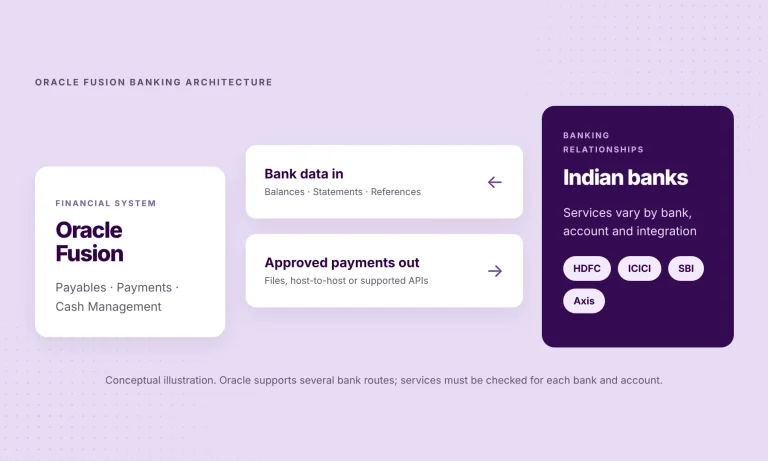
Bank integration is sometimes discussed as one connection. In practice, at least three information flows deserve separate attention.
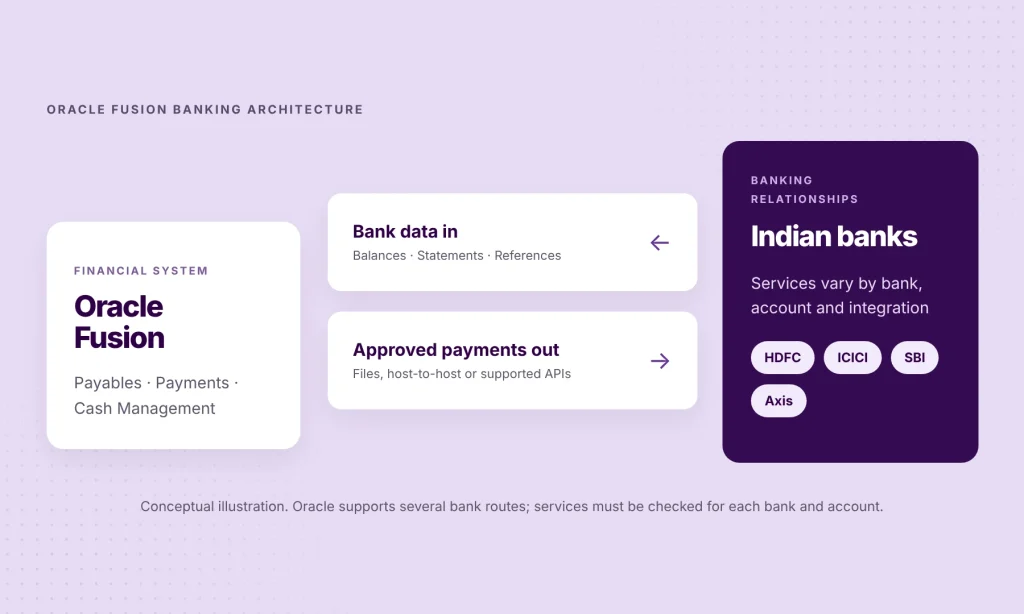
The central distinction. Oracle Fusion manages financial processes and accounting controls. Bank connectivity determines how supported balances, statements, payment instructions and responses cross the boundary between the ERP and each bank.
- Payment instructions going out. The ERP prepares and approves disbursements. A configured transmission path delivers those instructions to the bank or payment system.
- Bank responses coming back. An acceptance or rejection is useful, but it isn’t always proof of final settlement. The team must establish what status data and references its banks provide.
- Bank statements coming in. Statement data supplies the transaction evidence used in Cash Management, where Oracle’s reconciliation rules and accounting controls operate.
| Workflow | Oracle Fusion | Connectivity | Bank |
|---|---|---|---|
| 01 · Payment instruction out → | Payables and Payments Supplier payment selected, approved and formatted by the payment process profile | Transmission Bank-specific file, host-to-host or supported API | Bank receives instruction Validates and processes it |
| 02 · Bank response back ← | Payment follow-up Review status and references | Response Acceptance, rejection or processing update, where available | Bank outcome Acknowledgement is not settlement |
| 03 · Statement data back ← | Cash Management Import, rule-based matching and exception review | Statement delivery Transactions and references in a supported format | Booked transaction Reported in the bank’s statement data |
The architecture matters because a connection may support only one part of the cycle. A reliable statement import doesn’t mean payments can be initiated through the same route. And a successfully transmitted payment instruction doesn’t mean the final bank transaction has been reconciled.
For a finance controller, that distinction means fewer unexplained items between an ERP payment run and the cash book. For an Oracle implementation owner, it means explicit interfaces, error handling and test cases rather than a vague requirement to “integrate the bank”.
Why Indian multi-bank environments require a closer look
For Oracle Fusion bank connectivity, the challenge is not simply the number of bank accounts. It is the variation behind them.
A company might need daily closing statements from one bank, more frequent cash visibility from another and payment initiation from a third. Some banks may use established host-to-host or secure-file connections; other services may be available through APIs. The timing and detail of payment statuses may differ as well.
Indian payment requirements also introduce operational decisions. NEFT, RTGS and IMPS may all be relevant, but each bank account’s payment services, authorisation requirements and approval configuration must be verified.
Complexity grows for groups with several legal entities and business units. A statement that arrives from the correct bank but is mapped to the wrong Oracle bank account can be as disruptive as a missing one. The same applies to a correctly formatted payment file that uses the wrong disbursement-account setup.
The best integration isn’t the one promising the most banks on a slide. It’s the one whose coverage, account mapping, approval controls and exception handling match the company’s operating model.
Four approaches to Oracle Fusion bank connectivity
1. Existing bank file and host-to-host arrangements
Many enterprises already exchange statement or payment files with banks through secure channels. Oracle can load supported electronic bank statement formats, and Oracle Payments can format and transmit payment files through configured payment systems.
This can remain a sensible approach when the connections are stable. The costs arise when several banks each need separate onboarding, formats, schedules, monitoring or support. Those costs are worth evaluating, rather than assuming every legacy connection needs replacing.
2. Oracle-supported embedded banking services
Oracle also offers embedded banking for specific bank and regional scenarios. For example, Oracle documents integrated banking services with Bank of America for customers in the US and Canada, currently in controlled availability. Arrangements like this show that Oracle can provide more automated bank communication where the relevant service is offered.
They shouldn’t be mistaken for universal coverage across Indian banks. Eligibility, bank availability and the exact workflow must be checked for the enterprise’s location and accounts.
3. Direct integrations built for individual banks
An enterprise or its implementation partner can build and maintain an integration for a particular bank. This gives control over message transformation, monitoring and bank-specific workflows, but the team also takes on changing interfaces and the work of running several connections over time.
For organisations with a few specialised bank relationships, that investment may be reasonable. For growing multi-bank groups, the repeated engineering and support work adds up.
4. A common multi-bank API layer
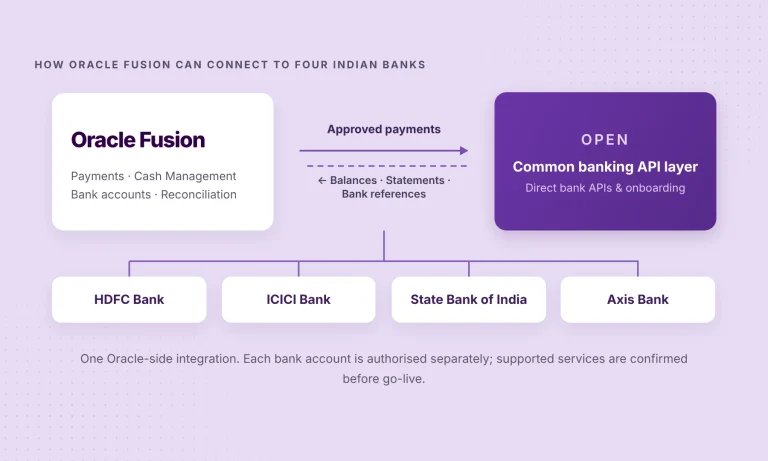
A specialist connectivity provider can maintain the bank-specific connections and expose supported services through a shared integration layer. The Oracle-side integration then works with one consistent interface for bank data and payment instructions, instead of negotiating every bank connection separately.
This can reduce duplication where the relevant banks and services are supported. It doesn’t remove bank authorisation, ERP field mapping, approval design or the need to test each workflow. Nor does it mean an organisation must disconnect arrangements that already work.
| Approach | Where it can work well | What still needs attention |
|---|---|---|
| Bank files and host-to-host | Established, predictable bank relationships | File formats, schedules, monitoring and changes |
| Oracle embedded banking | Bank and regional arrangements explicitly supported by Oracle | Eligibility, service coverage and configuration |
| Bank-specific custom integrations | Specialised requirements that need direct control | Build effort, maintenance and operational ownership |
| Common multi-bank API layer | Several supported Indian banks with repeatable requirements | Bank permissions, Oracle mapping, statuses and exception handling |
Oracle Fusion bank connectivity choices should be made bank by bank and workflow by workflow, not by comparing technologies in isolation.
Where OPEN fits in an Oracle Fusion banking architecture
OPEN offers an integration for Oracle Fusion Cloud ERP. It covers three activities. Balances and statement lines come into the ERP, payments approved in Oracle go out through OPEN, and settled payments post back with their bank reference. Sync status is visible, so failures can be followed up.
OPEN connects to more than 40 Indian banks, including HDFC Bank, ICICI Bank, State Bank of India and Axis Bank. A bank being connected doesn’t mean every account can use every service. Account eligibility, payment permissions, data availability and implementation scope must be confirmed.
| Layer | Responsible for | What it covers |
|---|---|---|
| Oracle Fusion Cloud ERP | Finance rules and accounting | Payment approvals, bank-account mapping, import validation, matching and reconciliation |
| OPEN integration | Bank connectivity | Balances and statements in, approved instructions out, bank references and sync monitoring |
| Connected banks | Authorisation and execution | Account permissions, payment processing and the bank’s final transaction evidence |
A clear division of responsibility. Oracle Payments continues to run the payment-processing and approval workflows. Oracle Cash Management continues to apply the configured reconciliation logic. OPEN supplies the banking connectivity and related integration services.
For a finance team, the potential benefit is less time gathering banking information outside Oracle and a clearer path from approved instruction to bank evidence. For an Oracle project owner, it is an integration approach that can be tested against real banks, entities and transaction workflows.
There is no reason to promise that every bank-specific host-to-host connection disappears on day one. A practical implementation may keep some established channels and introduce a common API layer where it adds value.
What an enterprise should verify before implementation
Before choosing an architecture, ask the implementation team and connectivity provider to document six things.
- Bank and account coverage. Which legal entities, current accounts and other account types are in scope? Which services are available for each?
- Oracle mapping. How will each bank account map to the correct legal entity, business unit and disbursement or reconciliation setup?
- Data availability. What balance and statement information is available, how often and with which identifiers?
- Payment controls. Which Oracle approvals remain in place, what bank authorisation is required and which payment methods are supported?
- Acknowledgement versus settlement. How are bank rejections, processing responses, final references and reversals handled?
- Reconciliation and operations. Which rules perform matching, how are exceptions escalated and who monitors failed syncs?
A useful pilot uses a small but representative sample: at least one real bank account, a statement import, a supported payment if authorised, and a traceable bank result. Only after those checks should the enterprise plan a broader rollout.
The outcome to optimise is a dependable financial workflow
Oracle Fusion already provides substantial capability for payments and cash management. The question is how consistently those capabilities work with the banks and accounts that sit outside the ERP.
Good Oracle Fusion bank connectivity makes the boundary visible. Finance knows which transactions have been sent and what evidence has come back. ERP owners know where transformation and monitoring happen. Approvers keep their controls. Reconciliation still takes place in Oracle, using reliable incoming data.
For Indian enterprises with several banking relationships, that is a more useful goal than simply reducing the number of integration interfaces.
Understand how your banks can work with Oracle Fusion.
Review the accounts, payment workflows and statement information your team needs. We’ll help assess the supported services and an integration approach worth testing.
Frequently asked questions
Does Oracle Fusion Cloud ERP already support bank integration?
Yes. Oracle Fusion Payments supports payment-file processing and configured transmission, while Oracle Cash Management supports electronic statement imports and reconciliation. The available connections and configuration depend on the bank, environment and integration method.
Can Oracle Fusion import MT940 and ISO 20022 bank statements?
Oracle documents support for SWIFT MT940, BAI2, EDIFACT FINSTA and specified ISO 20022 camt.052 and camt.053 versions. A real bank file still needs to match the supported format and configuration.
Is a bank API the same as automatic reconciliation?
No. The connection moves supported data or instructions between systems. Oracle Cash Management uses configured matching rules and manual exception workflows to reconcile bank statement lines against transactions.
Must an enterprise replace existing host-to-host connections?
No. Existing connections can stay where they serve the business reliably. A common API layer can be evaluated for new banks, new services or parts of the process that are hard to maintain.
Does OPEN support every service for HDFC, ICICI, SBI and Axis accounts?
OPEN lists those banks on its platform, but services depend on the particular account, permissions, payment methods and integration setup. Confirm the supported workflows during technical scoping.
Ready to connect specific banks? Read How to Connect HDFC, ICICI, SBI and Axis Bank to Oracle Fusion Cloud ERP for a step-by-step implementation guide.
Technical references
- Oracle: How electronic bank statements are processed — supported statement formats
- Oracle: How disbursements are processed — payment process requests and transmission
- Oracle: Automatic reconciliation — rule sets and exceptions
- Oracle: Payment process profiles — formatting, grouping and transmission
- Oracle: Integrated banking with Bank of America — embedded banking for US and Canada customers
- OPEN for Oracle Fusion Cloud ERP — integration capabilities
- OPEN integrations — supported ERPs and banks