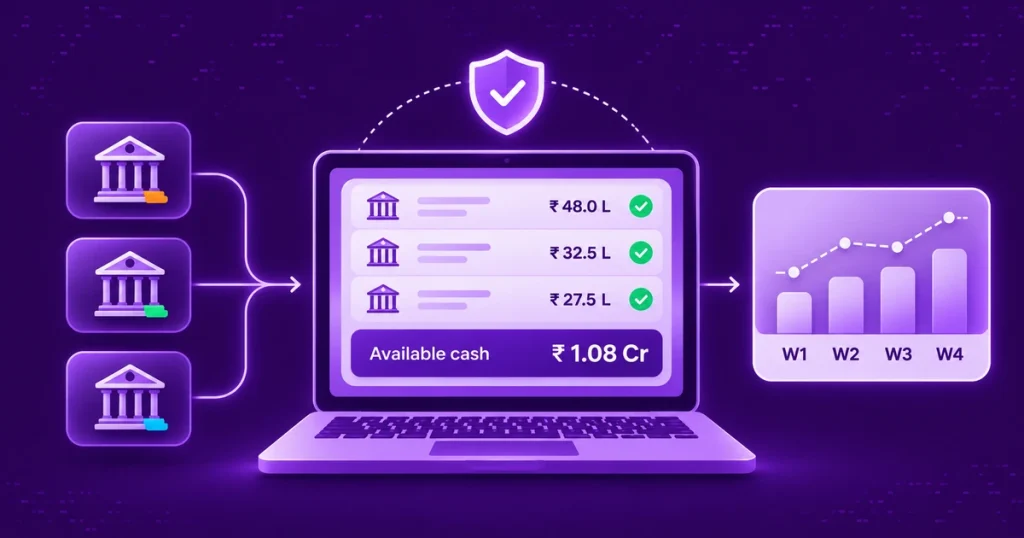
A finance controller opens Monday’s cash report. The spreadsheet says the business has ₹1.2 crore across four bank accounts. Yet when treasury checks which payments can actually be released this week, the answer is much lower. Some funds are on hold, one account belongs to a subsidiary, and a large customer receipt hasn’t arrived.
The CFO’s next question matters more than the headline balance: will we have enough usable cash for payroll, vendors and taxes when those payments fall due? That’s what cash flow forecasting should answer. But a forecast is only useful if its starting cash position is trustworthy.
This guide explains how Indian businesses can build a practical cash flow forecast, why accurate bank balances come first, and how connected banking helps finance teams start with better information, without confusing cash visibility with forecasting software.
At a glance
- A cash flow forecast looks forward. It estimates when money will enter and leave the business; today’s bank balance is only its starting point.
- Not every reported rupee is available to spend. Account ownership, holds, pending transactions and bank cut-offs all matter.
- Start small. A weekly forecast updated with actual bank movements and a realistic payment schedule beats a complex model built on stale data.
What is cash flow forecasting?
Cash flow forecasting estimates the cash a business expects to receive, pay and have available over a future period. Unlike a profit forecast, it focuses on when cash changes hands, not when revenue is recognised or an expense is recorded.
For example, a manufacturer may issue a ₹40 lakh invoice in November, but if the customer is expected to pay in January, that money can’t fund December payroll. Likewise, an approved supplier invoice should appear as a planned cash outflow on its expected payment date, rather than its booking date.
The core formula is simple: projected closing cash = opening cash + expected receipts − planned payments. Each period’s closing balance becomes the next period’s opening balance. For a day-to-day operating forecast, the opening figure should be a clearly defined, usable cash position, adjusted for items not yet reflected in bank data.
A business can forecast daily for the next few weeks, weekly over 13 weeks, or monthly over a longer planning horizon. The right frequency depends on payment volumes, volatility and the decisions finance needs to make.
Why accurate bank balances come first
The simplest forecasting mistake is starting with a cash figure that looks precise but isn’t usable. An accounting ledger, a downloaded statement and a bank’s available balance can all show different amounts at the same moment, because they answer related but different questions.
| Figure | What it tells finance | What to check before forecasting |
|---|---|---|
| Ledger or book cash | Cash recorded in the ERP or accounting system | Unpresented cheques, uncleared deposits, bank charges and posting delays |
| Statement balance | Transactions included in the bank statement at its cut-off | Statement date, account, missing periods and late postings |
| Available bank balance | Funds the bank reports as available for transactions | Holds, account permissions and when the balance was refreshed |
| Forecast opening cash | The usable position finance chooses as its starting point | Legal-entity scope, in-transit items, restrictions and reconciliation adjustments |
Consider a business with accounts at HDFC Bank, ICICI Bank, Axis Bank and SBI. A group-level total is useful for visibility, but it doesn’t necessarily represent what one legal entity can use to pay suppliers tomorrow. Transfers between entities may need approvals, documentation and time.
Example: ₹1.2 crore in bank balances, but less usable cash
| Account | Entity | Reported balance | Available balance |
|---|---|---|---|
| HDFC Bank – operations | Company A | ₹45 lakh | ₹36 lakh |
| ICICI Bank – collections | Company A | ₹28 lakh | ₹28 lakh |
| Axis Bank – payroll | Company A | ₹16 lakh | ₹14 lakh |
| SBI – subsidiary | Company B | ₹31 lakh | ₹30 lakh |
| Total | — | ₹120 lakh | ₹108 lakh |
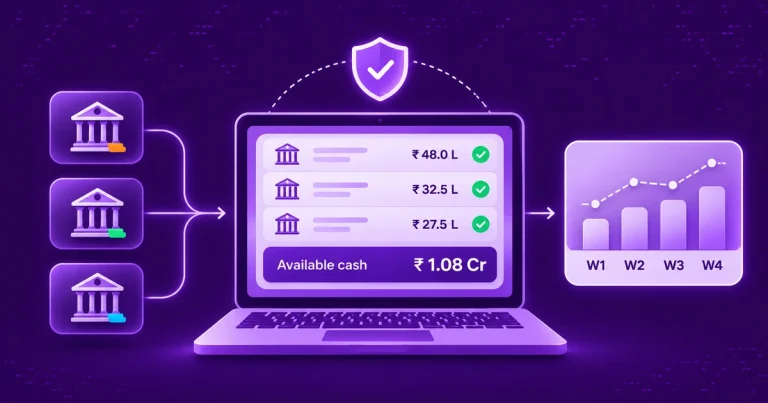
The group has ₹1.08 crore in available balances, but Company A’s three accounts hold only ₹78 lakh of it. Company B’s ₹30 lakh isn’t automatically Company A’s money for operational payments. If the forecast is for Company A, ₹78 lakh is the relevant starting point, subject to checks for pending debits, credits and account-specific restrictions.
This matters most for businesses with multiple plants, subsidiaries, project accounts or collection accounts. A consolidated view should always let finance drill down by entity and account. For more on that foundation, read our guide to multi-bank cash visibility.
Five data gaps that make cash forecasts unreliable
1. Balances are collected at different times
A statement downloaded on Friday and another downloaded on Monday don’t share the same cash cut-off. When accounts are updated by hand, the “consolidated balance” may combine transactions from different days. Record the as-of date and time for each account, including any bank posting or refresh limits.
2. Expected receipts are mistaken for available cash
An invoice marked due isn’t a bank credit. Customer collections may arrive late, partially or after deductions such as TDS. Keep projected receipts in the forecast, but don’t add them to the opening balance until they’ve actually arrived. Base expected receipt dates on collection history and confirmed customer information, not invoice terms alone.
3. Payments in transit aren’t accounted for
A payment submitted through an ERP or corporate bank portal may still be pending, rejected or awaiting bank-side authorisation. A cheque issued but not yet presented may not reduce the bank’s available balance either. Keep a controlled list of material in-transit items and clear them as outcomes become known. Our payment reconciliation guide explains how to track each payout through to settlement.
4. Internal transfers are counted twice
If Company A moves ₹10 lakh from one of its own accounts to another, the business hasn’t earned or spent ₹10 lakh. Counting the incoming credit as new cash while keeping the outgoing balance inflates the forecast. Identify inter-account transfers separately from operating inflows and outflows.
5. Overdraft limits and restricted funds are mixed with cash
An overdraft or cash-credit facility provides liquidity, but the undrawn limit isn’t cash already in the account. Likewise, funds earmarked for an entity, project or contractual obligation may not be freely deployable. Show available borrowing capacity separately and specify which balances the business can actually use.
A simple four-week cash flow forecast for an Indian business
Back to Company A, which starts with ₹78 lakh of available cash after its bank and entity checks. The finance team now adds expected customer collections and planned outflows: vendor payments, payroll, GST, TDS, rent, loan instalments and operating costs.
| ₹ lakh | Week 1 | Week 2 | Week 3 | Week 4 |
|---|---|---|---|---|
| Opening cash | 78 | 65 | 29 | 38 |
| Expected receipts | 35 | 20 | 48 | 30 |
| Planned payments | 48 | 56 | 39 | 33 |
| Forecast closing cash | 65 | 29 | 38 | 35 |
The four-week model shows no negative closing balance, but that doesn’t make the payment plan safe. Suppose all ₹20 lakh of Week 2 receipts slips to Week 3. Week 2 closing cash falls from ₹29 lakh to ₹9 lakh. If treasury keeps a ₹15 lakh minimum operating buffer, the revised forecast shows a ₹6 lakh shortfall that needs action before Week 2.
That’s why the forecast must be updated as bank credits arrive and scheduled outflows change. A beautiful spreadsheet can’t make up for a stale opening balance or optimistic collection dates.
₹1.2 crore across banks. How much can your business actually use?
When balances are scattered across bank portals, even the starting point of a cash forecast takes work. See how OPEN brings supported balances and statements from connected accounts into one view.
How to build a reliable 13-week cash flow forecast
A rolling 13-week forecast gives the CFO and treasury team a short-term view of cash needs without relying entirely on annual budgets. It can live in a spreadsheet or a treasury system. What matters first is that its inputs, owners and review process are clear.
Step 1: List every bank account and define the scope
Create an account register showing the bank, entity, account purpose, currency if relevant, balance source and the person responsible for reviewing it. Decide whether you’re forecasting one company or a consolidated group, and don’t combine intercompany balances without a clear method for eliminating transfers.
Step 2: Establish a dated opening cash position
Collect the latest balances from every account in scope and record a common cut-off. Compare material differences against the ERP cash ledger, identify holds or unreconciled items, and document adjustments. Your opening figure should be explainable by account and legal entity.
Step 3: Estimate receipts by realistic collection date
Start with open receivables, confirmed customer commitments, expected recurring collections and any other material inflows. Use actual customer payment behaviour where you have it. Separate confirmed collections from uncertain ones, and don’t treat a sales forecast as cash already due.
Step 4: Schedule all planned payments
Bring together approved vendor payables, payroll, statutory payments, rent, debt servicing, capital expenditure and other planned outflows. Identify which are contractual, which can be rescheduled through the proper approval process and which depend on operational decisions. Our vendor payment automation guide explains how payment approvals and bank processing fit together.
In India, payroll and statutory payments create predictable cash pressure, with quarterly advance-tax instalments adding to the calendar. Common dates to plan around include:
- Payroll: according to the company’s salary payment schedule, often around the start of the month
- TDS deposit: generally by the 7th of the following month; for non-government deductors, TDS deducted in March is generally due by 30 April
- PF and ESI contributions: generally by the 15th of the following month, subject to applicable extensions
- GST payment with GSTR-3B: generally by the 20th of the following month for monthly filers; quarterly-filer schedules differ
- Advance tax: generally on 15 June, 15 September, 15 December and 15 March for taxpayers following the standard instalment schedule
Build the applicable due dates into the payment calendar, and update forecast amounts as tax and payroll liabilities become clearer. Check for any extensions or special rules that apply to your business.
Step 5: Calculate each weekly closing balance and test scenarios
For each of the 13 weeks, add expected receipts to opening cash and subtract planned payments, then carry the closing cash into the next week. Compare a base case with a delayed-collections case and an extra-expense case. Flag any week where projected cash falls below the agreed liquidity buffer.
Step 6: Update the forecast with actual bank movements
At least weekly, and more often when payments are heavy, replace past estimates with actual bank credits and debits. Investigate the gap between forecast and actual cash, including delays, unexpected charges, missing statement data and payments that didn’t complete. Keep a short variance log with owners and next steps.
You don’t need all 13 weeks on day one. A well-controlled four-week view that later rolls out to 13 weeks is a practical start. Consistent inputs and review habits matter more than the first model’s complexity.
The bank-data checklist every forecast should pass
| Check | What finance should be able to answer |
|---|---|
| Bank and account coverage | Have we included every operating account relevant to this forecast? |
| Entity mapping | Which legal entity owns each balance, and can it fund these payments? |
| Data timing | When was each balance refreshed, and what is its bank-side cut-off? |
| Usable funds | Are holds, restrictions and in-transit payments accounted for? |
| Transaction completeness | Are statement days, credits, debits or reversals missing or duplicated? |
| Ownership and controls | Who reconciles differences and signs off the opening position? |
If the team struggles to answer the first three questions, the first priority may be better bank connectivity and cash visibility rather than a new forecasting engine. Our cash management software guide covers the broader capabilities to compare.
It also helps to keep three related processes distinct. A cash position tells you what’s available now, a cash flow forecast estimates what will be available later, and bank reconciliation checks that bank transactions agree with your accounting records. They support each other, but software that does one shouldn’t be assumed to do all three.
How OPEN Connected Banking supports better forecast inputs
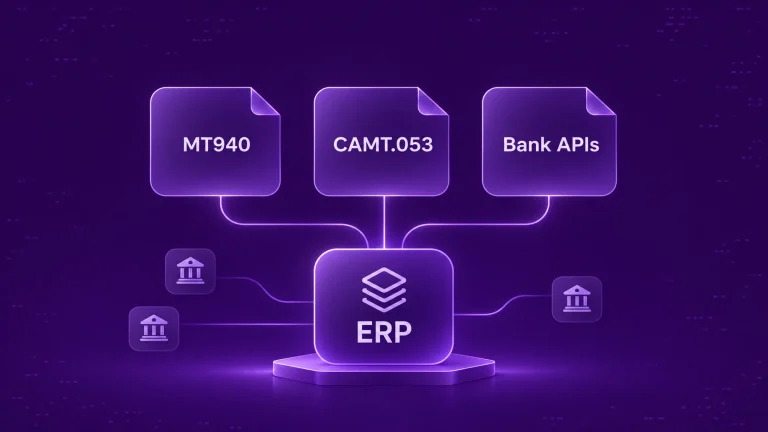
OPEN Connected Banking can bring supported balances and statements from eligible existing accounts across its network of 40+ Indian banks into one place. Available integrations can help carry that banking data into supported ERP and finance workflows, depending on the bank, account and configuration.
For a controller preparing a cash forecast, that means fewer separate bank-portal checks and an easier way to assemble an account-level opening position. Finance can then combine it with receivables, payables, planned investments and operating assumptions in its own forecasting process. For the ERP side, see why finance teams connect bank accounts to their ERP.
Important distinction: OPEN provides the bank data your forecast starts from; the forecast itself, including scenarios, assumptions and payment decisions, stays with your finance team and systems. Account services and refresh schedules vary by bank, so confirm them for the accounts in scope.
Frequently asked questions
What is the basic cash flow forecasting formula?
Projected closing cash equals opening cash plus expected receipts minus planned payments. Carry each period’s closing figure into the next period, and use a consistent, explainable opening position rather than an old bank balance.
How is a cash flow forecast different from a cash flow statement?
A cash flow statement reports historical cash movements over an accounting period. A forecast estimates future receipts, payments and balances, using assumptions that should be updated against actual results.
Why is multi-bank visibility important for cash flow forecasting?
Companies often collect revenue, pay vendors and hold reserves through different banks and entities. A complete, dated bank view helps finance pick the right starting position and avoid missing or double-counting accounts.
Should I use the ledger balance or the available bank balance?
Both are useful but serve different purposes. For a short-term liquidity forecast, start with the funds actually available to the relevant entity, then reconcile material differences with the ledger, pending payments and bank cut-offs. Document the basis you use.
Is a 13-week cash flow forecast necessary for every Indian business?
No. A 13-week forecast is a useful short-term format, especially when collections and payments vary. A smaller business can start with four weeks and extend the horizon once its inputs and review process are stable.
Can connected banking automatically forecast my future cash flow?
Connected banking improves access to balances and transactions, which are key forecast inputs. Predicting collections, choosing payment dates and modelling scenarios still need a forecasting process or suitable finance software.
Start with the cash you can verify
Cash flow forecasting doesn’t begin with a complicated prediction. It begins with a plain question: what cash does the business actually have available, in which accounts, as of when? Once finance can answer that consistently, it can add realistic receipts, scheduled payments and scenarios to see what the next few weeks may look like.
For Indian businesses working across several banks, reliable statement access and account-level cash visibility are the practical foundation. Build the opening position first. Then build a forecast the CFO can question, review and act on.
Your forecast needs a clear starting balance. Your banks don’t need to change.
See how OPEN brings supported balances and bank statements from eligible existing accounts into one place, giving your finance team a clearer starting point for cash planning.